
Find a book

A Book a Month
We can send a book a month for six or twelve months - the perfect gift. More »

Café Music
Listen to our album of Café Music while browsing the site. More »

A parallel in pictures to the world of Persephone Books.
To subscribe, enter your email address below and click 'Subscribe'.
4 February 2019
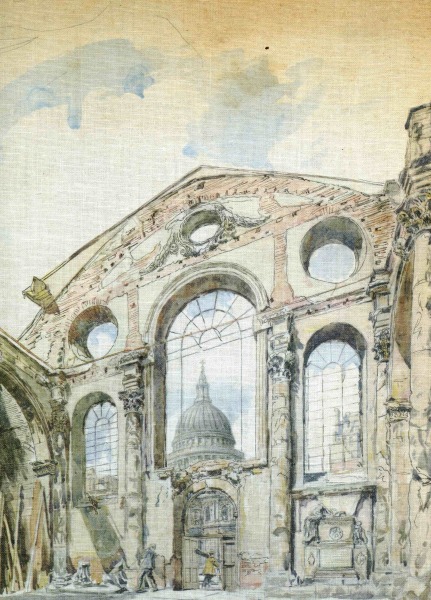
We were given a wonderful ‘vintage’ book for Christmas. Bombed London by Hanslip Fletcher was published in 1947. The Preface, while bemoaning what had been lost (Bloomsbury squares being gated, fields three miles from Charing Cross ablaze with buttercups) expressed pride because ‘today we are all conscious of being citizens of a noble and heroic city where at least ideas are free and liberal’. Let’s hold on to this. The frontispiece is St Paul’s through Bow Church Window. That St Paul’s survived the blitz was a miracle in itself.
1 February 2019
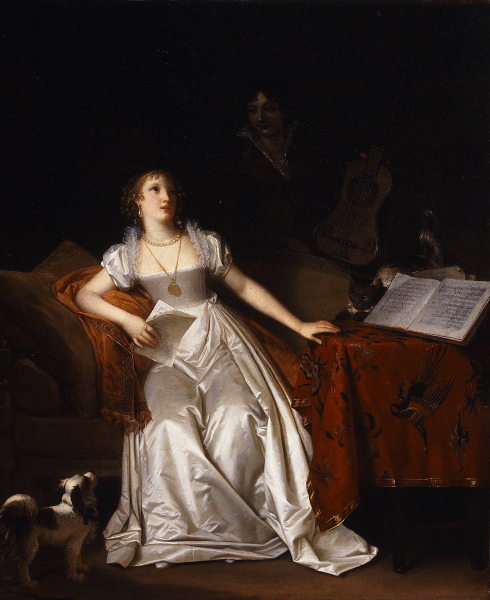
The French painter Marguerite Gérard (1761-1837), who apparently never demonstrated any interest in joining the Academy, and never married, had a tremendously successful career. She won three medals for her work, which she exhibited regularly once the Salons were opened to women in the 1790s. Her pictures were acquired by luminaries such as Napoleon and King Louis XVII. Prelude to a Concert was painted in 1810. Here is more about her on a blog called Towards Emancipation: Women in Modern European History.
31 January 2019
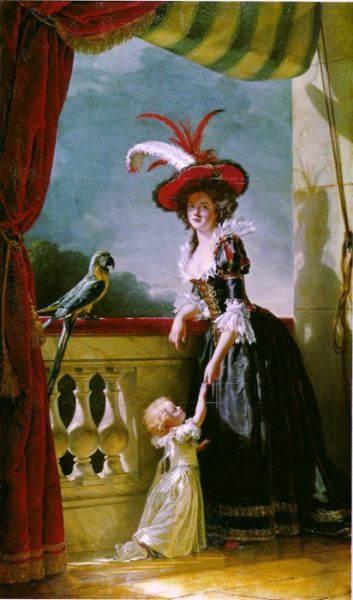
Adélaïde Labille-Guiard (1749-1803) was known for her portraits at a young age, and she became a member of the French Royal Academy. She worked for numerous royal and aristocratic patrons. In 1783 she was admitted to the Academy and was awarded the title Peintre des Mesdames (painter to the king’s aunts), a government pension, and an apartment at the Louvre.
30 January 2019
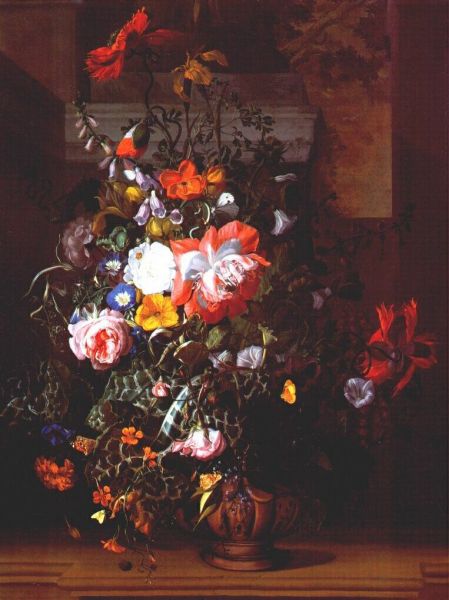
Rachel Ruysch (1664-1750), only painted flowers. She was married and had ten children; yet her talent was widely recognised by her contemporaries. (It seems as if these talented women weren’t ignored in their – often long – lifetimes, it’s afterwards they are quite forgotten, when it’s only the reputations of their male contemporaries that survive. Men forge reputations maybe.)
29 January 2019
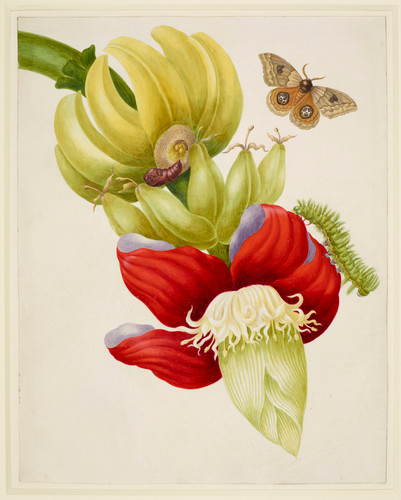
Maria Sibylla Merian (1647-1717) was a German painter and naturalist who was revered during her lifetime for her huge talent. Her name may not be familiar to most of us but that is our loss: many people do recognise her as a very important naturalist. There are examples of her work in the Royal Collection and two years ago there was an exhibition in her honour, details here (and there is a good lecture by her biographer). Bananas and Large Yellow Underwing Moth is dated 1705.
28 January 2019
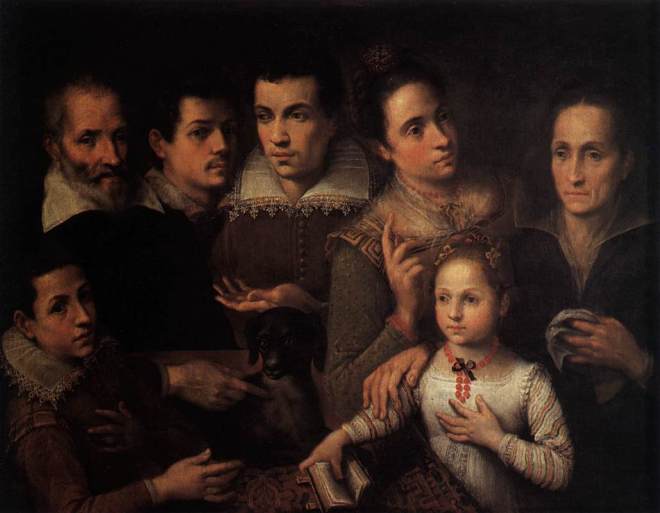
This week on the Persephone Post: five women artists of whom we had never heard, all of whom were obviously first class. So why oh why were they forgotten? Well we think we all know the answer. This is by the Italian Renaissance artist Lavinia Fontana (1552-1614). She was hugely encouraged by her father and was then the main breadwinner for a family of thirteen, she and her husband, who was her manager, having eleven children. And she painted more than a hundred paintings. Surely Salley Vickers or Sarah Dunant or Tracy Chevalier are even now plotting a novel about her? This is Family Portrait, but whose family we do not know.
25 January 2019
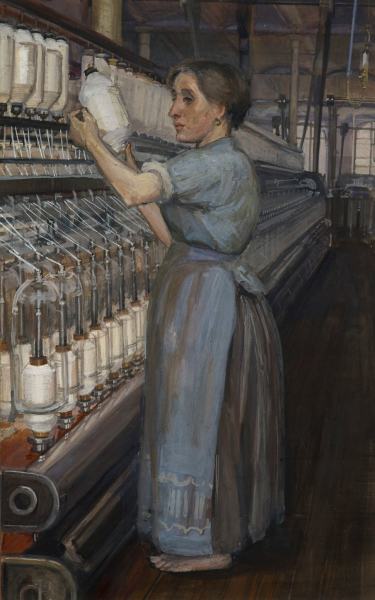
And finally the best painting of them all: In a Glasgow Cotton Spinning Mill: Changing the Bobbins. Apollo magazine again: ‘Sylvia Pankhurst publicised her tour’s findings, of poor working conditions and unequal wages, by writing an article and reproducing her images in the London Magazine in 1908. She never did complete her studies at the RCA, in part because she was not awarded a final-year scholarship – but also due to her belief that a successful artistic career would be in service of the pleasures of the wealthy elite and her own self-centred ambition, as opposed to society and its problems. She questioned her conscience: “Are we brothers of the brush entitled to the luxury of release from utilitarian production? Is it just that we should be permitted to devote out entire lives to the creation of beauty, while others are meshed in monotonous drudgery?” And so, at the age of 27, Sylvia Pankhurst turned her full attention to the suffragette cause, helping to establish the first branch of the WSPU in London.’