
Find a book

A Book a Month
We can send a book a month for six or twelve months - the perfect gift. More »

Café Music
Listen to our album of Café Music while browsing the site. More »

A parallel in pictures to the world of Persephone Books.
To subscribe, enter your email address below and click 'Subscribe'.
6 December 2018
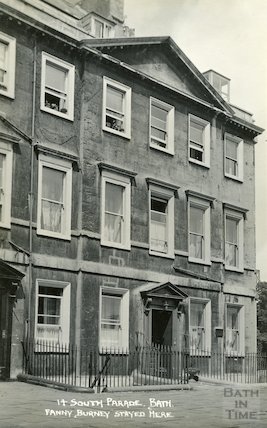
Fanny Burney visited Bath frequently. Two years after Evelina was published in 1778 she stayed for a few weeks at 14 South Parade with Mr and Mrs Thrale, the friends of Dr Johnson. And from 1815-18 she lived at 23 Great Stanhope Street. She had written to a friend: ‘I wish to live in Bath, wish it devoutly, for at Bath we shall live, or nowhere in England. Bath is… the only place for us since here, all the year round there is always the town at command and always the country for prospect, exercise and delight.’ (Fanny Burney lived for much of her adult life in France, which is why she did not live in Bath permanently.)
5 December 2018
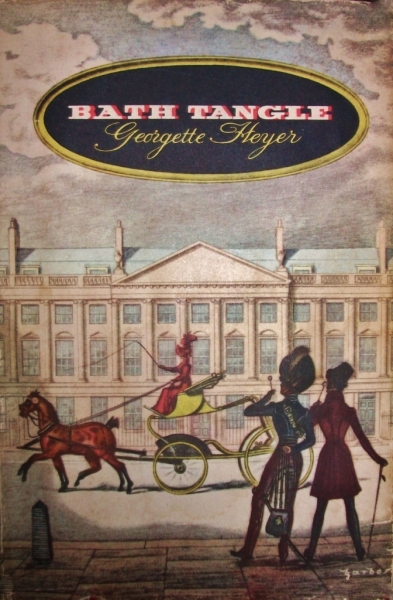
Many of the novels written by Georgette Heyer (1902-74) take place in Regency Bath. Bath Tangle (1955), for example, is set in Bath in 1816.
4 December 2018
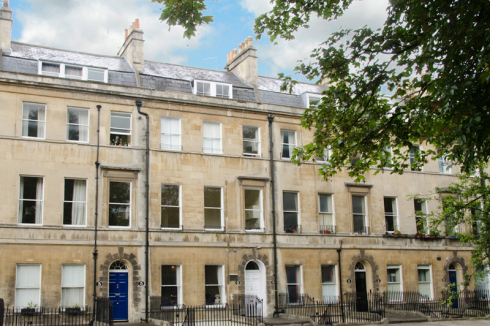
Jane Austen lived from 1801-4 at 4 Sydney Place. It was on the outskirts of Bath, looking out onto the open countryside. Here is a website that gives details about her time there.
3 December 2018
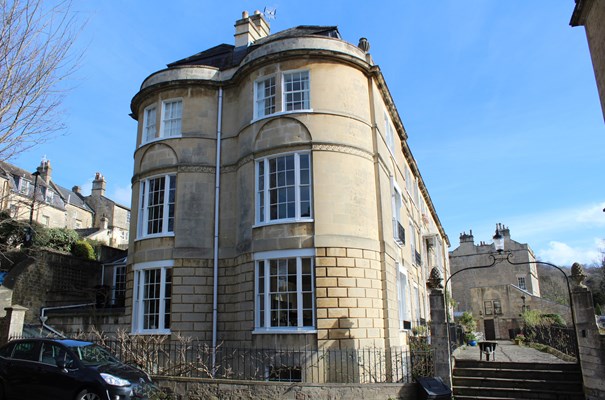
In some ways The Sack of Bath is a slightly left-field book for Persephone to have published. But we think it is a central part of our list. Obviously it is not a novel by a mid twentieth-century woman writer. But it is about the domestic and how to live in a town, and in this respect is a sequel to Middlemarch when Dorothea is so pitied by her sister because she is going to live in a street and, as George Eliot tells us, she will lead ‘a hidden life’. But this was not an unimportant life. It was a domestic life, in a townhouse, with neighbours through the wall and other people all around. And the ‘hidden’ of course refers to the domesticity, crucial but undervalued. For anyone interested in novels by women writers, Bath is an important place to visit, even for the day. This week on the Post: five streets where writers lived or with which they were connected. First of all Widcombe Terrace (photograph from the English Heritage Listing site here) where Virginia Woolf’s great-grandfather stayed, and wrote about, for a few weeks in 1812.
30 November 2018
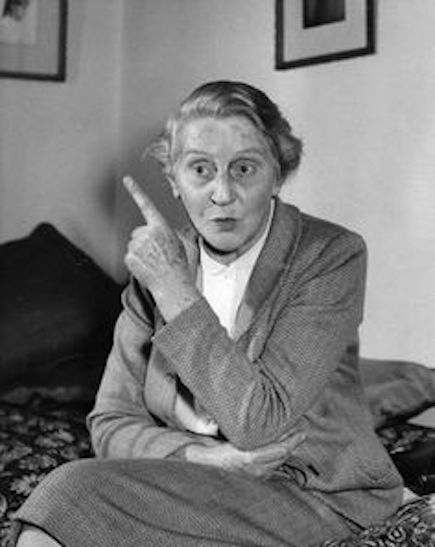
Emily Blathwayt, the mother of WSPU member Mary Blathwayt,wrote in her diary in 1911 after Charlotte visited them (quoted on Spartacus here): ‘Miss Marsh planted her tree. She greatly dislikes her first name Charlotte and all her friends call her Charlie. Her label will be C. A. L. Marsh. (She also goes by the name of Calm). We liked very much what we saw of her. She is very fair with light hair and a pretty face. She is very tall … She has a wonderful constitution and seems very well after all she has gone through. She has begun the late custom of not taking meat or chicken. She seems a very nice quiet girl.’ Charlotte, or Charlie, died in 1961, here she is not long before her death: she never lost any of her spirit.’
29 November 2018
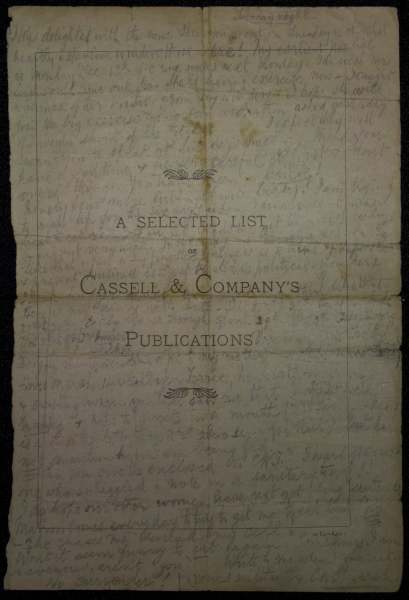
Charlotte wrote to Selina about the force-feeding she so bravely endured, on this page torn from a book. It’s now on display in Manchester.
28 November 2018
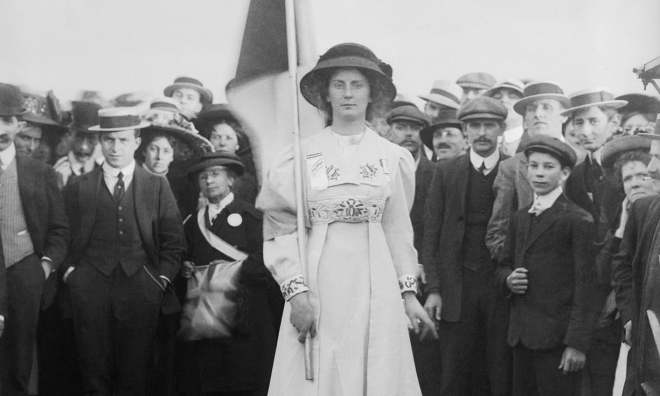 ‘Charlotte Marsh joined the Women’s Social and Political Union in 1907, at the age of 20. She did not, however, become active in the movement until 1908 when she finished her training as a sanitary inspector’ (Museum of London website here). What a wonderful detail – a sanitary inspector! Then a suffragette organiser. (And a motor mechanic and driver during the war.) Charlotte was photographed by Christina Broom on 18 June 1908 when she was the Grand Marshall for this Women’s Sunday Procession in Hyde Park.