
Find a book

A Book a Month
We can send a book a month for six or twelve months - the perfect gift. More »

Café Music
Listen to our album of Café Music while browsing the site. More »

A parallel in pictures to the world of Persephone Books.
To subscribe, enter your email address below and click 'Subscribe'.
10 September 2018
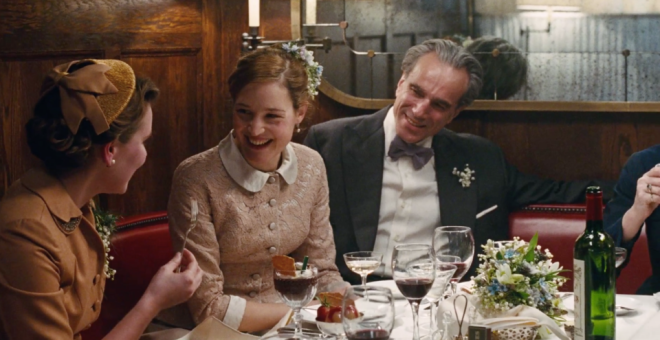 For the Persephone girls the last year has been an incredible one for films (and a dire one for the theatre, but let’s draw a veil). There have been FIVE amazing films, which we shall celebrate on the Post this week. First of all Phantom Thread. Jonathan Romney wrote about it here: ‘Phantom Thread is partly a nightmare of male tyranny, another story of what women have to put up when dealing with over-indulged male artists — though that could make it sound as cloth-eared as mother!. Instead, Anderson’s fine-tuned script perfectly captures the little spats of delicate, polite jousting, and also very credibly creates a tone of mid-’50s England. The direction, the elegant pacing, the attention to detail all bring the impression of depth, when the film might easily appear to merely be gliding on beautifully polished surfaces; it all creates a sense of prickly nuance that carries a distinct flavor of Henry James.’ And here is the trailer.
7 September 2018
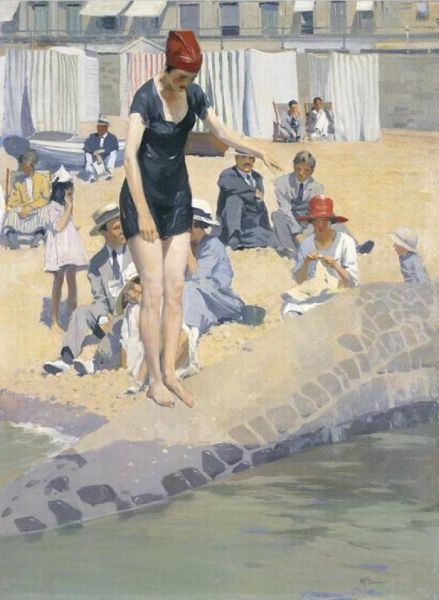
More sunbathers: July by the Sea was sold at Sotheby’s in 2003 and here is some of the extremely interesting catalogue note (which once again demonstrates that paintings are simply novels and short stories in a different format). ‘Gunn studied at Glasgow School of Art from 1909, going on to Edinburgh College of Art and later the Académie Julian in Paris. Despite his essentially Scottish training, and strong demand in London for his services as a glamorous society portraitist, it has been Gunn’s beach scenes, the majority painted on the Continent, that are most consistently sought-after by collectors. Le Havre and Dieppe was the source of inspiration for a number of beach scenes (probably Sunbathers). It seems that the present work must have been painted either at Etretat, or alternatively somewhere along the Sussex coast. Gunn enjoyed family holidays on the English ‘Riviera’ in the 1920s with his first wife Gwendoline Hillman, whom he had married in 1919, and their three daughters, Diana, Elizabeth and Pauline, before the marriage was dissolved in 1927. However, the awnings shading the windows of the buildings lying along the promenade here are much more typically French than English, as is perhaps the fact that there are a number of well-dressed men on the beach, possibly enjoying a leisurely break from work nearby. Rather than looking out to sea, as with the majority of his other beach scenes, with July by the Sea the artist turns his gaze inland, to observe in closer detail the various visitors to the beach. One charming incident is the young girl with a large beribboned hat, who looks directly at the observer from behind the knees of the central figure, appearing to laugh at the artist as he works. Great detail of observation (a man’s small moustache; a woman’s hands busy about her sewing; the girl’s right foot slightly braced as she holds her grip on the slippery groin) is unified here under the intensity of the light from the sun, which sits directly overhead and casts minimal shadow. The light bounces off the white of the striped changing tents, shirtfronts, a newspaper idly held in the distance, and the bleached sand itself. The colour palette is schematically restricted to bright primaries, relaxing into a subtle green only to suggest the coolness of the water at the diver’s feet. The picture appears to be laid out and arranged with greater consideration than the obscuring of four of the figures supplying narrative, behind the body of the standing girl, would immediately suggest. It strikes the viewer as an instantaneous impression, a holiday ‘snapshot’. However, four parallel bands describe the background in carefully graduated intervals (the buildings, the tents, the sand, the water) while within these bands pockets of action are carefully placed so as to balance each other, the whole unified by the strong vertical of the bather in her clinging Edwardian suit. The two seated on deckchairs in the right distance balance the crowd gathered towards the lower left. The left arm of the hesitant swimmer emphasises a diagonal line running through the seated figures on the beach behind her – the same diagonal that will be echoed as she makes her jump. The dark-suited man seated in the central section of the canvas watches the swimmer and anticipates her arc towards the empty lower right quarter, thus supplying a narrative anchor. Just as he waits, we wait, and in so doing can almost feel the sun.’
6 September 2018
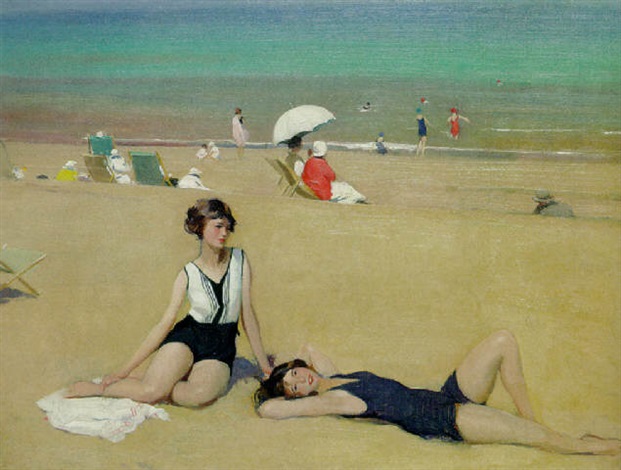
Sunbathers was sold at Christie’s in 1999 and is now in a private collection. It is undated. James Gunn painted several beach scenes, mostly in France where this probably is.
5 September 2018
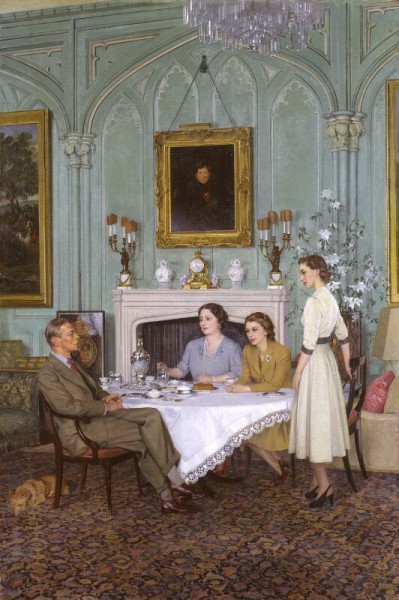
Conversation Piece at the Royal Lodge, Windsor. For those of us who have seen The Crown, this painting has all kinds of extra resonances. It’s at the National Portrait Gallery.
4 September 2018
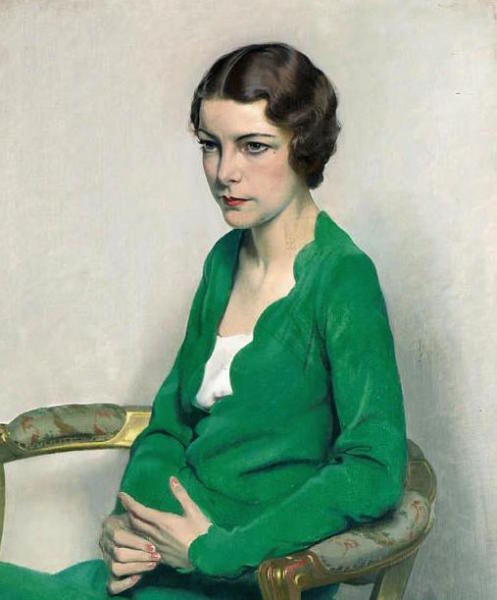
Portrait of a Lady Wearing a Green Dress 1929 is James Gunn at his inimitable best. As the 1994 Scottish NPG exhibition catalogue said: ‘His stylish portraits of the great and glamorous delighted critics and visitors to the Royal Academy’s annual summer exhibition for nearly four decades.’ He was the visual equivalent of John Galsworthy, Somerset Maugham, Charles Morgan or Compton Mackenzie ie. read by the same kind of people and, some would argue, now curiously dated. (In the way, others would argue, including ourselves, that ‘our’ authors eg. Dorothy Whipple or Norah Hoult or Dorothy B Hughes are not dated.)
3 September 2018
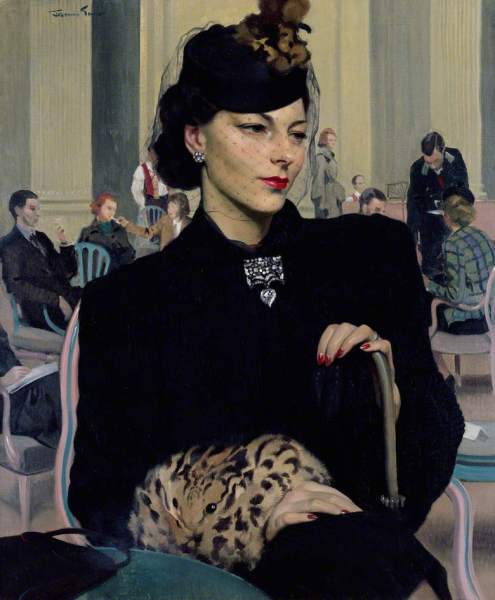
On the Post this week: Sir James Gunn (1893-1964) who painted the beautiful portrait on the front of the Classic edition of Someone at a Distance. This painting is also ‘Pauline’ (his wife), this time as Pauline Waiting 1939: we have used it to illustrate The Two Mrs Abbotts since it’s a wartime novel and wartime involved hours and hours, indeed years and years, of waiting.
31 August 2018
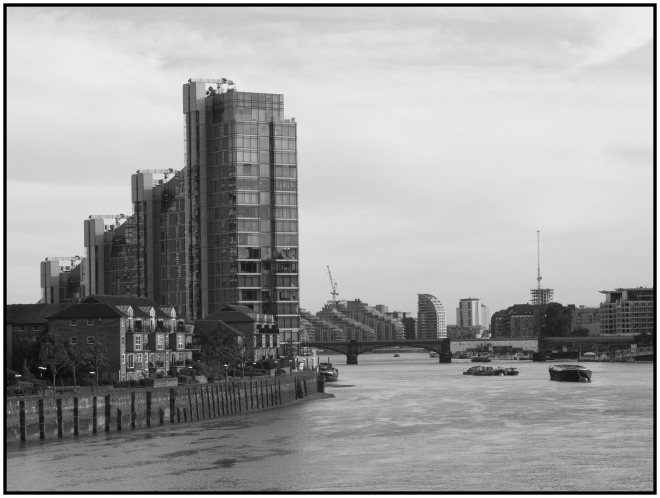
‘The fourth and final part of London Symphony acts as a love letter to the Thames looking at the differences in the bridges and surrounding areas, and feels like an appropriate end to our visit to London.’ And, throughout, the especially composed music, by James McWilliam, is superb: a marvellous film that isn’t easily forgotten.