
Find a book

A Book a Month
We can send a book a month for six or twelve months - the perfect gift. More »

Café Music
Listen to our album of Café Music while browsing the site. More »

A parallel in pictures to the world of Persephone Books.
To subscribe, enter your email address below and click 'Subscribe'.
20 June 2018
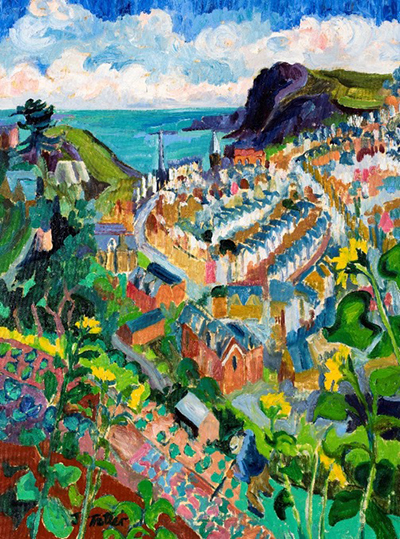
This is Ilfracombe. Anne Dumas, the curator and art critic, is quoted as saying: ‘Josephine Trotter’s latest work shows her at the height of her powers. She is an artist rooted in the tradition of modern Post-Impressionist painting but her deeply felt, poetic response to her native landscape brings a strong and totally individual vision to her subjects. She is a superlative painter in the truest sense of the word.’
19 June 2018
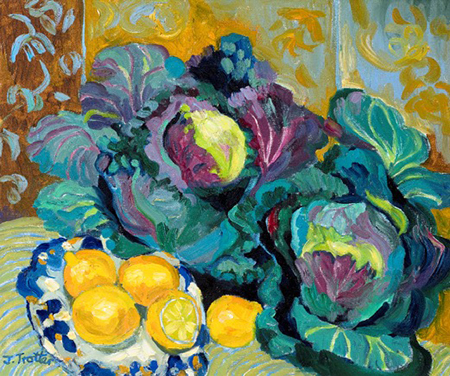
The exhibition that has just opened (it finishes at the end of this week) is Josephine Trotter’s twenty-first. ‘She is an artist who has a powerful feeling for the material she uses: oil paint, in all its glorious physicality. She says “I get so excited about paint, its quality and application. Also, I feel privileged to have trained at a time when drawing was the crux and bones of art education and very hard work. The thing is, I really love painting.” That is abundantly evident from her exuberant work’ (Martin Gayford). This is the absolutely beautiful Cabbages.
18 June 2018
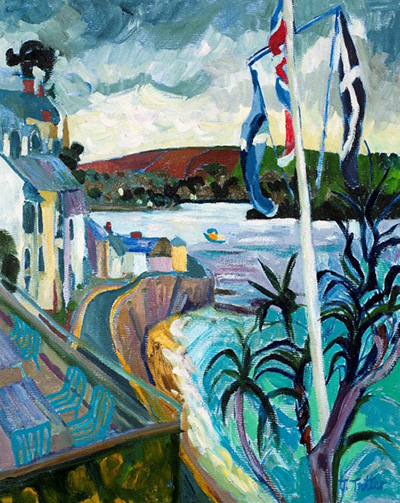
Unsung women painters is a constant riff on the Post. This week, the stunning Josephine Trotter, b. 1940.’Her latest exhibition is a series of oil paintings of British landscapes from the northernmost tip of Scotland down to Dorset and Devon’ (more here). This is Hotel Tresanton, St Mawes.
15 June 2018
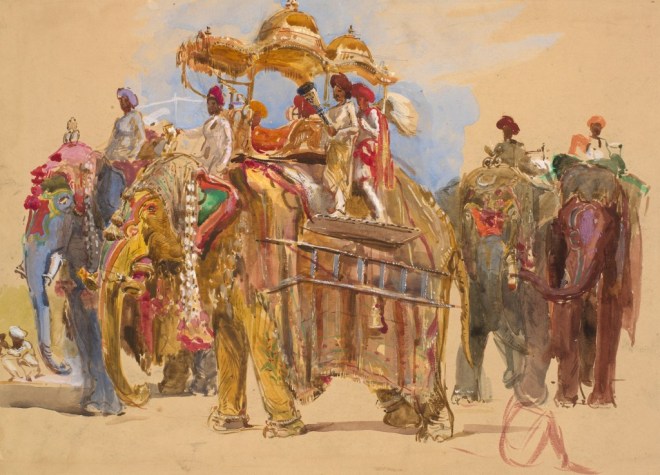
‘In October 1875, Prince Albert Edward (known as ‘Bertie’ to his family) set off on a four-month tour of the Indian subcontinent; as future King, he was expected to visit the Empire and learn about it, hopefully preparing him for his ultimate destiny of wearing the crown. The trip took Bertie to India, Sri Lanka, Pakistan and Nepal, travelling some 10,000 miles. Diplomatic gifts, much like today, are an important part of relationship building, and no expense was spared for the British royal party. The locals lavished expensive gifts on the Prince to welcome him, as did the 90+ different local rulers he met, and it is these treasures that form the ‘Splendours of the Subcontinent’ exhibition’ (here). This is State Elephants at Baroda.
14 June 2018
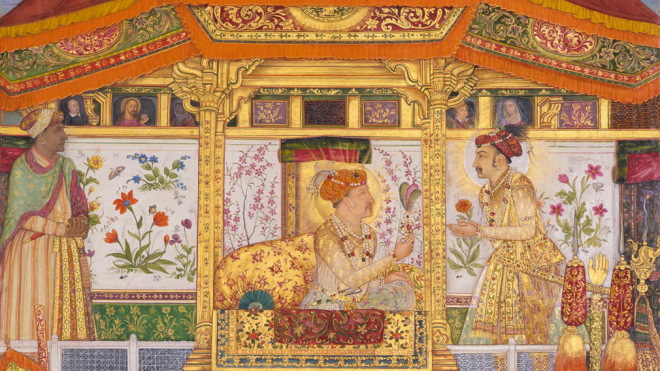
Detail from a painting in the Padshahnama manuscript (‘Book of Emperors’), 1656–7 , entire painting, and two more, here.
13 June 2018
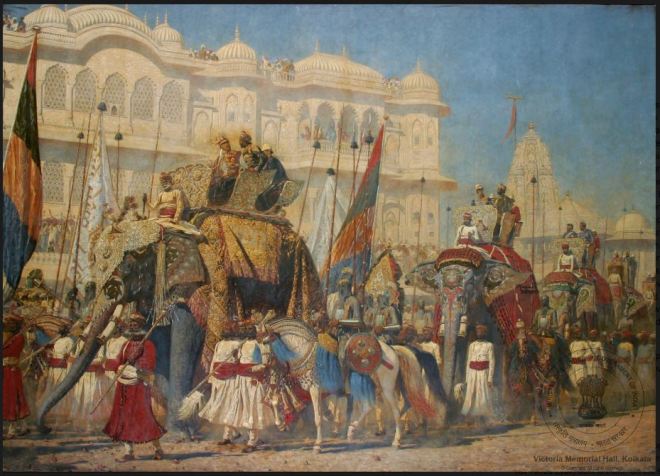
The Prince of Wales at Jaipur, 4th February 1876, The Elephant Procession by Vassili Vereshchagin. He ‘forsook his native Russia for India in 1874, where he was to remain for almost two years gathering ethnographic materials with which to colour an intended series of paintings devoted to the region. The works inspired by his time in India are extraordinarily beautiful and accomplished. He travelled extensively, his reverence for this rich land foreshadowing that of another Russian artist and Nobel Peace Prize nominee, Nicholas Roerich (1874-1947). Encounters with wild animals, almost drowning in a river, freezing on a mountain ledge and being plagued with tropical malaria did little to dampen his enthusiasm; his fervent interest in every aspect of local life roused the suspicions of the English colonial authorities who quickly, and somewhat ironically, became convinced he was spying for the homeland he had been obliged to quit. During his time in India Vereshchagin was deeply moved by what he perceived to be the plight of a great and ancient people at the hands of the British colonialists and determined to address the matter’ (further detail here).
12 June 2018
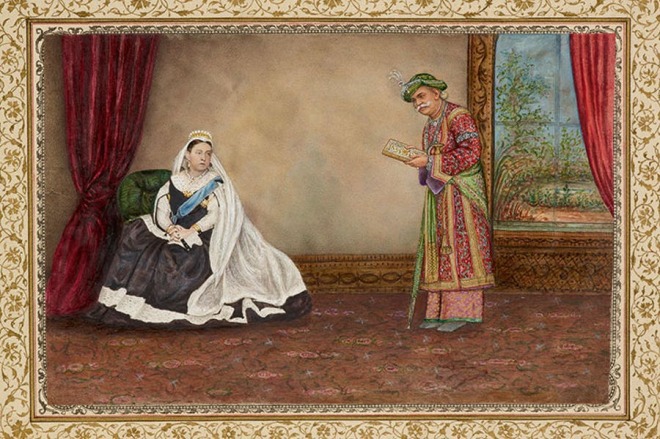
Painted frontispiece of The Queen’s Travels in Scotland and Ireland, translated into Hindi (1875), South Asia. Courtesy Royal Collection Trust; © Her Majesty Queen Elizabeth II 2018: obviously by an unknown painter, but what an incredible sense of proportion and colour and atmosphere.