
Find a book

A Book a Month
We can send a book a month for six or twelve months - the perfect gift. More »

Café Music
Listen to our album of Café Music while browsing the site. More »

A parallel in pictures to the world of Persephone Books.
To subscribe, enter your email address below and click 'Subscribe'.
16 May 2019
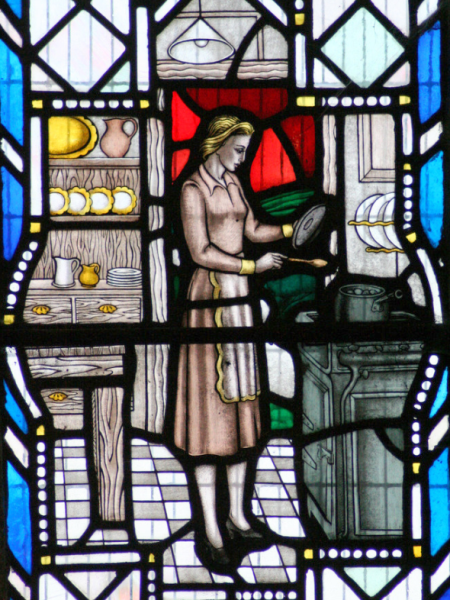
This is at St Stephen, St Stephen-in-Brannel, Cornwall, 1947, by George Cooper-Abbs (1901-66) for Wippell of Exeter. The two ovens look like an Aga but the top and the plate warming rack does not – so maybe the stove is a kind of hybrid cooker.
15 May 2019
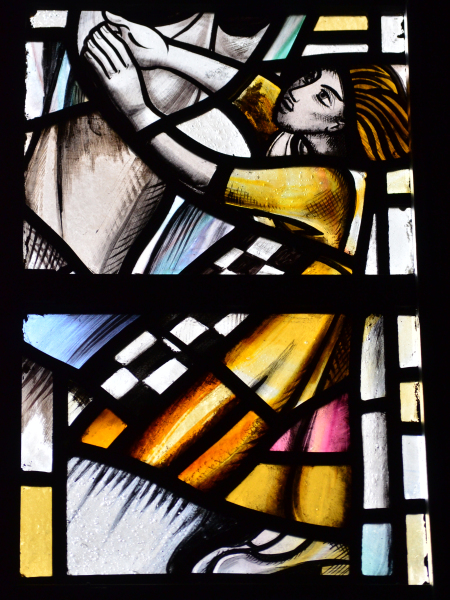
This window with a domestic subject is not in a church but in the staircase of an office building. It’s by William Wilson, 1939, and is a detail from the scheme in what was the Caledonian Insurance Company in Edinburgh. The building is now listed, here is more detail.
14 May 2019
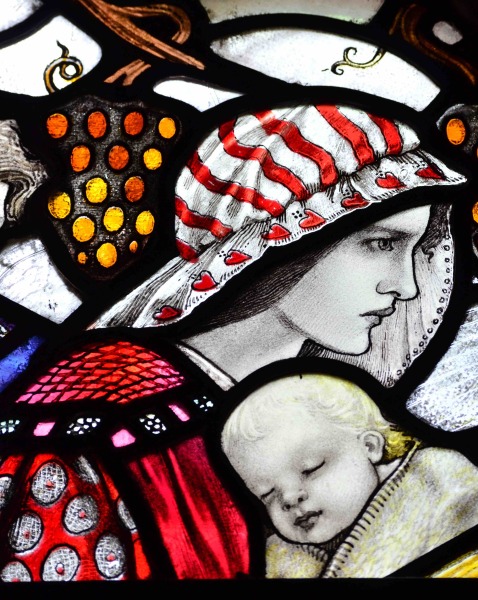
In one sense this is a classically beautiful 1912 Virgin and Child by Karl Parsons (1884-1934) at St Alban, Hindnead, Surrey. But look at the blanket stitch!
13 May 2019
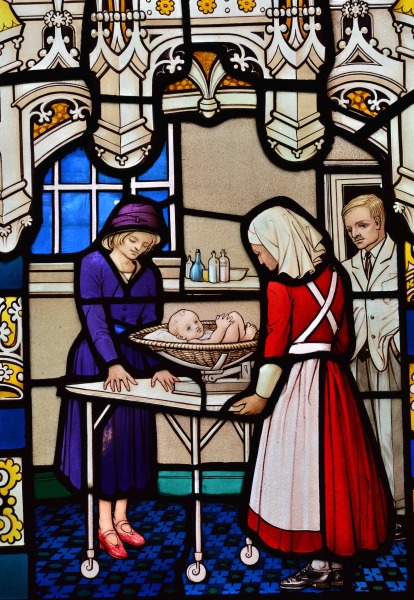
Extraordinary – you go in to a Norfolk church (St Peter, Blofield) and there is – a baby clinic. This is a detail from one of the two Harker memorial windows designed in 1936 by Reginald Bell (1886-1950): the windows (here) tell the story of Margaret Harker’s remarkable life: ‘As well as being deeply involved in her local Red Cross work she served as a Justice of the Peace, a prison visitor and was a regular worshipper at Blofield parish church.’ And that was only the half of it, thus ‘worried by the high rate of infant deaths she established, in 1919, an infant welfare clinic in the village. Thought to be the first such clinic in the county it provided a place where mothers could bring their children for weighing, advice and examination by a doctor, the doctor’s fees being paid by Mrs Harker. VAD nurses performed duties here under her leadership.’ (Nb, another consignment of Jane Brocket’s book has just arrived in the shop, it’s so heartening that Persephone readers read the Post and then order the book.)
10 May 2019
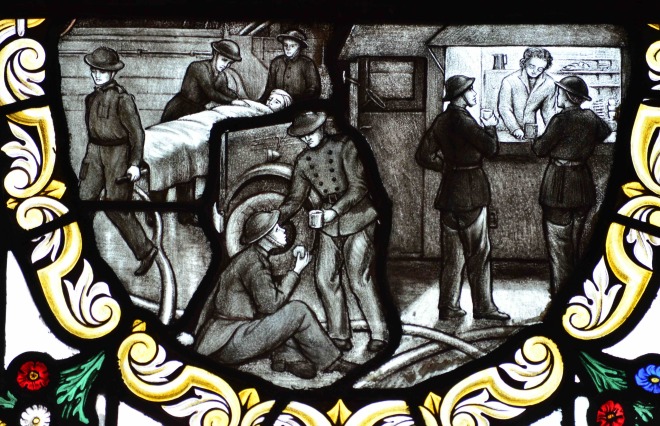
At All Saints, Maldon there is a modern interpretation by GER Smith (1883-1959) of the story of the Good Samaritan. It was donated by someone who, very sadly, lost his first wife and his second in the war. (More domestic stained glass on the Post next week because it is too beautiful to abandon after only four examples.)
9 May 2019
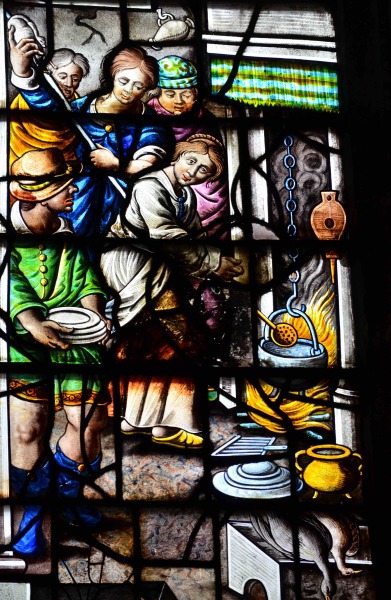
This actually is Martha and Mary. Those who have forgotten what they represent will find the original at Luke 10: ‘She [Martha] had a sister called Mary, who also sat at Jesus’s feet and heard His word. But Martha was distracted with much serving, and she approached Him and said, “Lord, do You not care that my sister has left me to serve alone? Therefore tell her to help me.” And Jesus answered and said to her, “Martha, Martha, you are worried and troubled about many things. But one thing is needed, and Mary has chosen that good part, which will not be taken from her’”‘ This crucial parable is explained more here eg. ‘Jesus said Mary made a conscious decision between two alternatives: She chose listening to Jesus over preparation of a meal. This may sound strange to those who, like Martha, think meal preparation is more important than visiting. But couldn’t that depend on who the guest is? The most pressing need in Martha’s eyes was that of preparing a meal for Jesus and His disciples. Mary saw this situation differently. She chose to listen to the wisdom of Jesus, her Saviour, while she had the opportunity.’ (Most Persephone books re-tell this parable in some way. Think Diary of a Provincial Lady; Mariana‘s mother; Celia in They Knew Mr Knight who so disastrously forgot to be Mary and became Martha; A House in the Country; Family Roundabout; A Fortnight in September; oh this is a fascinating riff.) Today’s window is in University College Chapel, Oxford, it’s late 1630s/early 1640s and is by Abraham van Linge.
8 May 2019
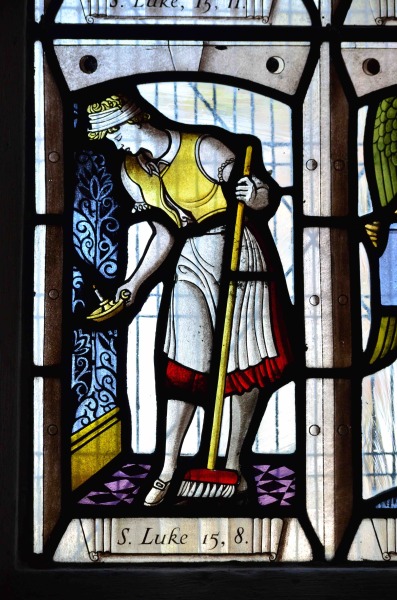
The Parable of the Lost Coin is at St Lawrence, Sandhurst, Glouc. It was designed by Harry Stammers in 1949. Jane Brocket has written eloquently on her blog here about his work opening up the whole world of stained glass for her. When she came across the windows by him in the Lucy Chapel at St Mary Redcliffe in Bristol. ‘I was amazed. I’d never seen ordinary people in ordinary, contemporary clothes. Headscarves! Handbags! Court shoes! Aprons! On women who weren’t saints or queens, but who probably scrubbed doorsteps and cleaned out stoves and swept floors, brought up children, and took them to Sunday school. Women who had a shampoo-and-set once a week, went shopping with baskets over their arms and wore sensible coats in winter. The kind of women I saw and knew when I was growing up: mothers, workers, wives, daughters. And here they were. Not beautified, idealised or objectified, but depicted with clarity and simplicity and dignity… I’d always assumed stained glass wasn’t my sort of thing, yet I found myself completely enthralled by a mix of post-war Social Realism, abstraction, woodcut linearity, book illustration, poster design, plus glorious colour, superb handling of huge windows, and masterly manipulation of light. Harry Stammers (1902-1969) was my introduction to stained glass, my way into looking at and appreciating an art that is so often excluded from art books. That is the story of my stained glass epiphany, my conversion.’