
Find a book

A Book a Month
We can send a book a month for six or twelve months - the perfect gift. More »

Café Music
Listen to our album of Café Music while browsing the site. More »

A parallel in pictures to the world of Persephone Books.
To subscribe, enter your email address below and click 'Subscribe'.
7 May 2019
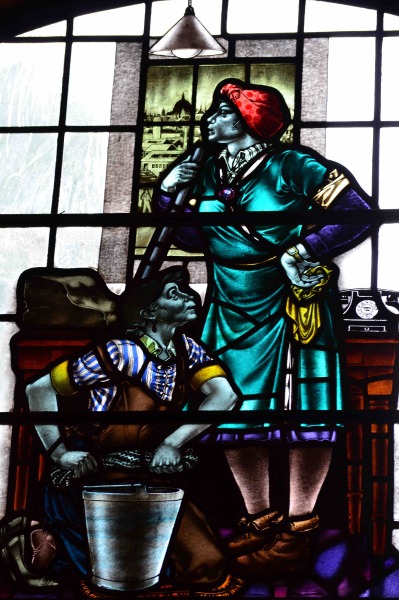
Who knew that domestic work sometimes featured in – stained glass? It doesn’t seem very likely but Jane Brocket, author of the excellent How to Look at Stained Glass (reviewed here by the Church Times, and of course we sell it in the shop) has discovered more instances than one could have dreamed of. This is in Christ Church, Southwark 1960/61 by FW Cole (1906-98), ‘I see these as modern-day versions of saints e.g.. Martha and Mary’ (Jane Brocket).
3 May 2019
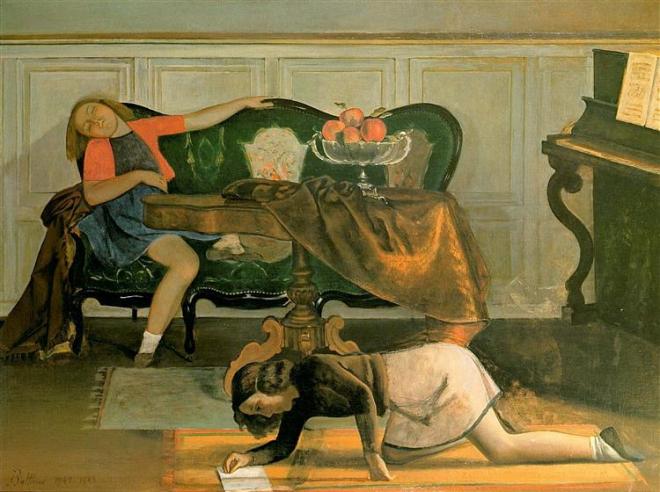
Finally this week: the Polish-French artist Balthus painted The Living Room in 1942. Here, at Tate’s website, is a revealing piece about him. The authors of Books do Furnish a Painting tell us that the model for both figures was Georgette, daughter of a local farmer. Apparently she once said ‘I do not care for books’ but you would not know this from the intensity with which she is reading.
2 May 2019
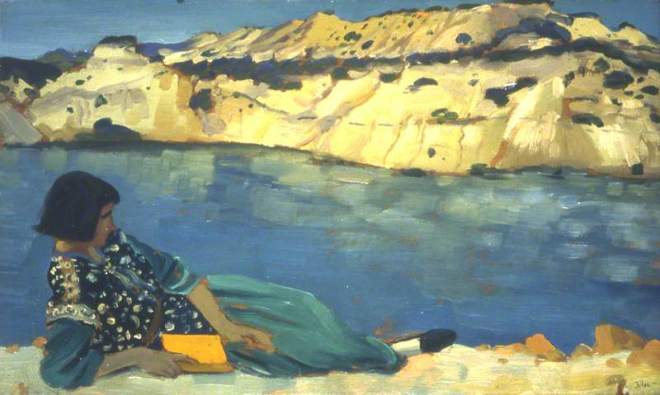 Augustus John The Blue Pool 1911 was painted in Dorset. It’s in Aberdeen. There is nothing to say about this painting except that everything about it is heavenly – Dorelia’s clothes, her haircut, the sea, the feeling of the freshest of fresh air.
1 May 2019
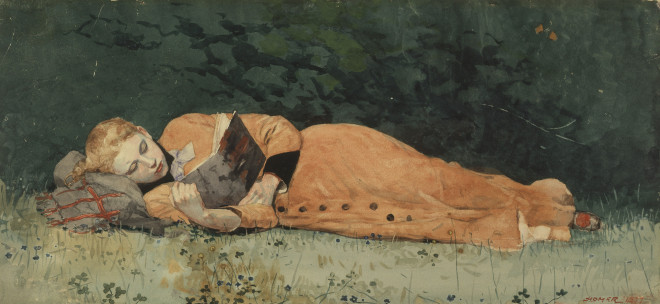 Winslow Homer’s The New Novel (1877) was, and still can be, seen as a moral statement about ‘only a novel’. Here for example is a piece by Book Patrol: ‘The image crackles with latent sexuality and the eroticism of feminine power. It is a deeply intimate portrait, and Homer seems to spying on her, enjoying the scene as a voyeur enraptured by the young girl’s complete lack of self-consciousness. Her foot emerges from her dress, stretched, cat-like, as if the passage she’s reading requires a physical response. Reading here is a pagan act, a mystic rite performed in a sylvan setting that almost begs for fauns spying upon her from within the background brush.’
30 April 2019
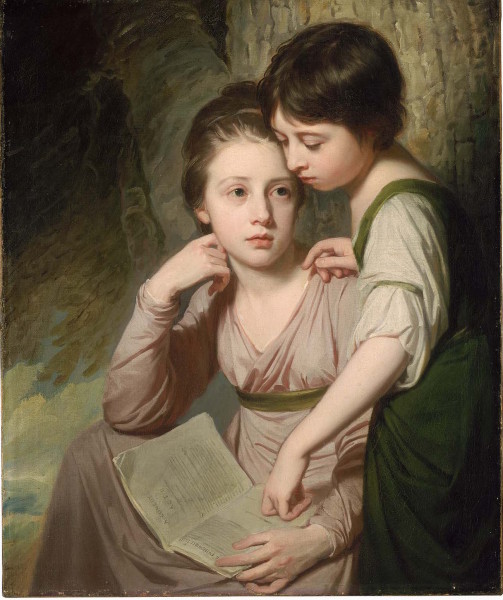
Portrait of Two Girls by George Romney was commissioned by the playwright Richard Cumberland in 1772. His two daughters Elizabeth and Sophia are reading their father’s latest play, The Fashionable Lover. The painting was inherited by Sophia, the younger girl, and stayed in the family until 1892 when her grandson sold it. It is now at the Museum of Fine Arts in Boston. ‘Romney constructs an affectionate and subtle narrative with the sisters’ differing responses. Elizabeth is on the cusp of adolescence and dressed in an “adult” gown: her dreamy stare suggests that the theme of fashionable love has sparked her imagination. Sophia, slim and childish in a green smock, struggles to understand the meaning of her father’s words’ (here). .
29 April 2019
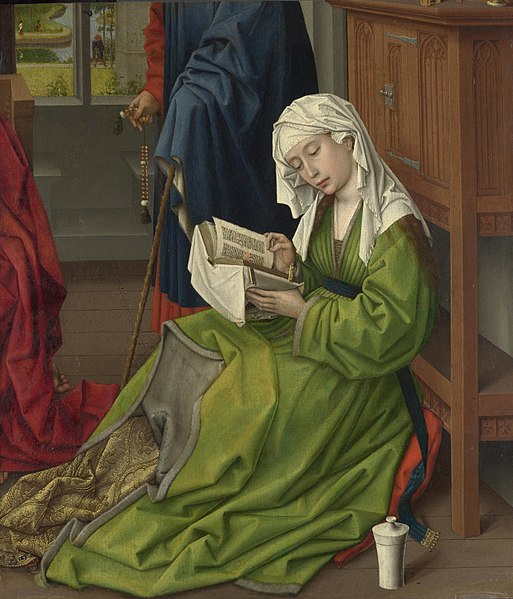
We were given the heavenly Books do Furnish a Painting by Jamie Camplin and Maria Ranauro: ‘Thousands of fine paintings include books in their subject matter. This companionable survey explains how and why books became the single most ubiquitous feature of our cultural lives and, in large measure, of our everyday existence’ (blurb). This is The Magdalena Reading (1438), probably by Rogier van der Weyden, it’s in the National Gallery. But what is the white porcelain object in the bottom right-hand corner? Ah ha, Wikipedia tells us it’s a jar of ointment (among other very interesting info).
26 April 2019
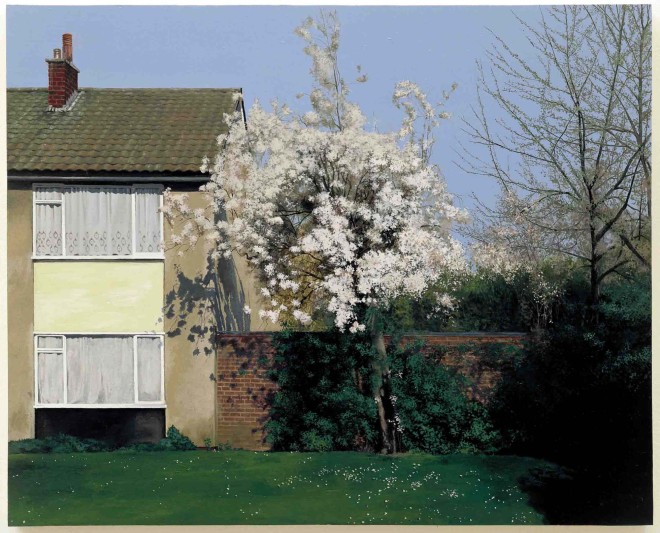
And finally The Blossomiest Blossom 2001 (presumably April of that year, judging by the amazing blossom all around us in the UK at the moment). The British Council website says: ‘The real subject of Shaw’s paintings is the weight of memory. Working meticulously in model-makers enamel, Shaw paints from his snapshots of the places of his childhood. Always empty of people, Shaw’s minutely detailed landscapes trace the artist’s determination to reconstruct not just the look, but the emotional charge of his memories. A far cry from a British landscape tradition in painting, this work does not glorify a rural idyll; instead it draws the viewer into the unremarkable, melancholy spaces between suburb and countryside – a geography familiar to adolescents wandering around the margins of their neighbourhood.’