
Find a book

A Book a Month
We can send a book a month for six or twelve months - the perfect gift. More »

Café Music
Listen to our album of Café Music while browsing the site. More »

A parallel in pictures to the world of Persephone Books.
To subscribe, enter your email address below and click 'Subscribe'.
5 March 2019
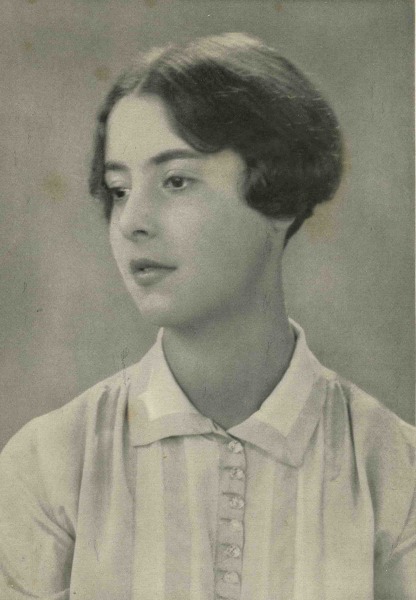
Cilly Aussem, a tennis champion, was only 21 in 1930 but by the end of that year was second in the world rankings. She had a charming and delightful personality, cf. the rather interesting Wikipedia entry here and encyclopedia.com here.
4 March 2019
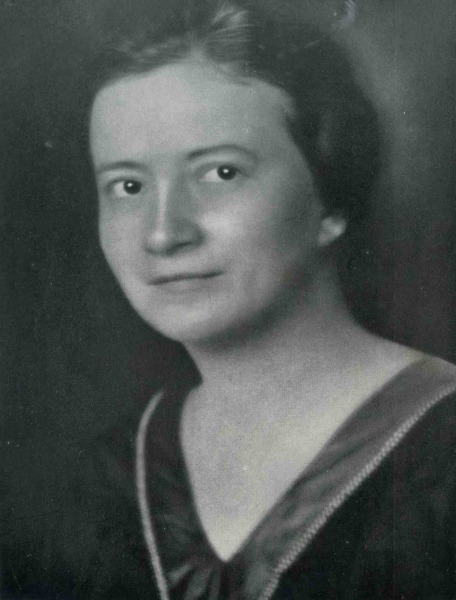
One of the extraordinary things about Germany in the 1920s (cf. Manja in particular) was the emancipation of German women. Educated German women could, it seems, do anything. Probably someone has written a book about this, and probably someone else has written a book or learned article about the consequences of Hitler’s hatred of educated, ambitious, middle-class women. Until some kind reader has recommended the article, or written it, this week on the Post we are simply having five photographs from a very curious book (undated, but according to the Catalogue of the German National Library here it seems to be 1930): Unsere Zeit in 77 Frauenbildnissen, which means ‘our times in 77 portraits of women’. You have never seen such a group of strong, intelligent, emancipated women! This is Dr Phil (which means doctor of philosophy) Lotte Moller, who was ‘Privatdozentin, Tiefseeforscherin, Assistentin am Institut fur Meereskunde in Berlin, which means ‘private lecturer, deep sea researcher, assistant at the institute for oceanography in Berlin’. The photograph was taken by Barbara von Winterfeld. Thanks to Google we can read all about the fascinating Sophie Charlotte Juliane Moller here, including the detail that in fact she gave up oceanography and specialised in hydrography because of the jealousy of one her male colleagues! (She joined the National Socialist Party, but until told otherwise we are going to assume that she did so not out of ideology but simply in order to keep her career going; nevertheless, it is deeply regrettable.))
1 March 2019
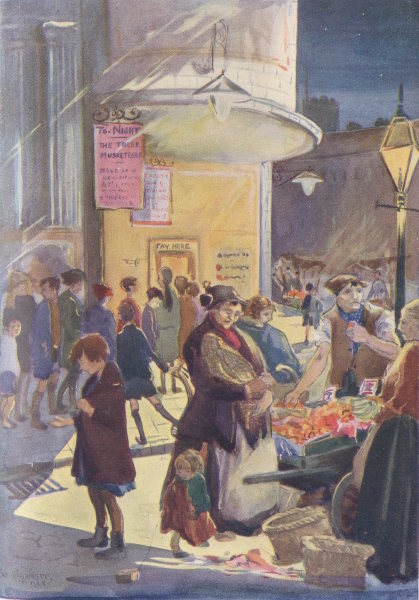
The Cinema Queue is the fourth colour plate. The tiny child at the front is surely staying with her grandmother, while her elder sister goes to the cinema. The poster says ‘To-night: The Three Musketeers’ (presumably the 1921 black and white version with Douglas Fairbanks, it’s on You Tube here).
28 February 2019
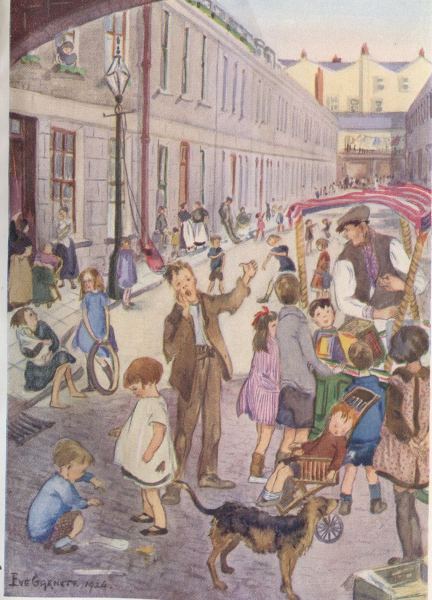
Another very Call the Midwife image. In many ways it was a marvellous life for the children of the East End (which is mostly what Evelyn Sharp writes about in her book).
27 February 2019
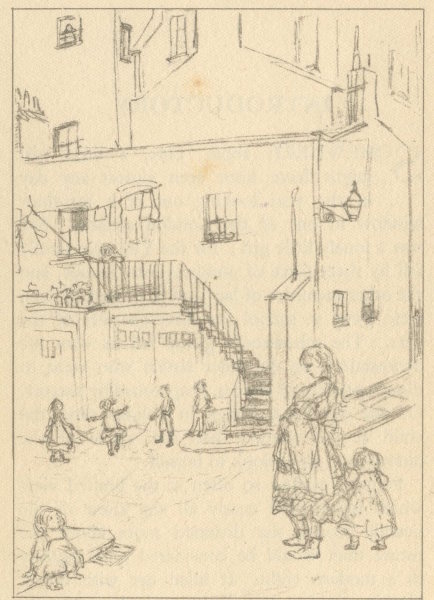
There are four colour plates and lots of pencil drawings. This one evokes Call the Midwife decades before Call the Midwife was written.
26 February 2019
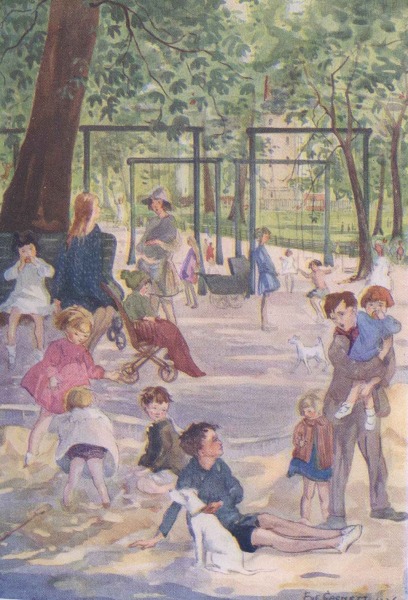
‘The Playground in the Park’. Happily, this still exists – all over the UK, although for how much longer? No, no, we must retain our optimism that one thing ‘austerity’ (aka taking from the poor to give to the rich) will not do is remove our children’s playgrounds.
25 February 2019
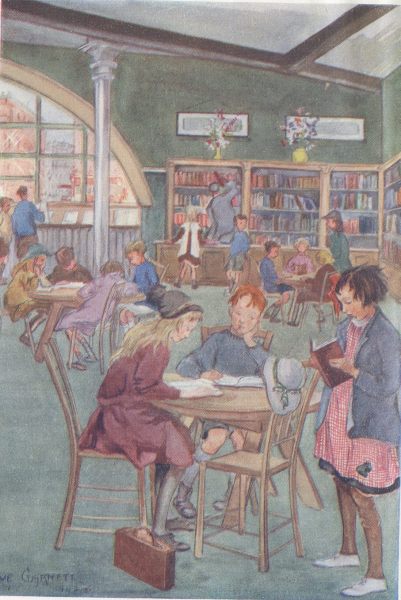
One of our new heroines is Evelyn Sharp (we have a short story by her in the forthcoming Second Persephone Book of Short Stories and she wrote a biography of Hertha Ayrton, the original of the scientist in The Call). She wrote a book called The London Child (1927) and the illustrations were by Eve Garnett (1900-91) of The Family from One End Street (1937) fame. These are children in their local library. Words cannot express how deeply we at Persephone feel about the appalling trashing of our libraries in the name of ‘austerity’, previous generations would not be able to believe it.