
Find a book

A Book a Month
We can send a book a month for six or twelve months - the perfect gift. More »

Café Music
Listen to our album of Café Music while browsing the site. More »

A parallel in pictures to the world of Persephone Books.
To subscribe, enter your email address below and click 'Subscribe'.
22 February 2019
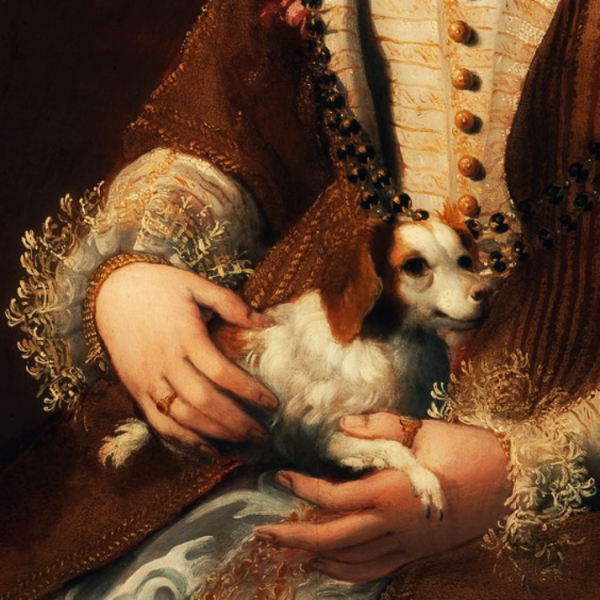
And finally, a detail in order to focus on the most important thing: Portrait of a Lady with a Dog is in the Auckland Art Gallery.
21 February 2019
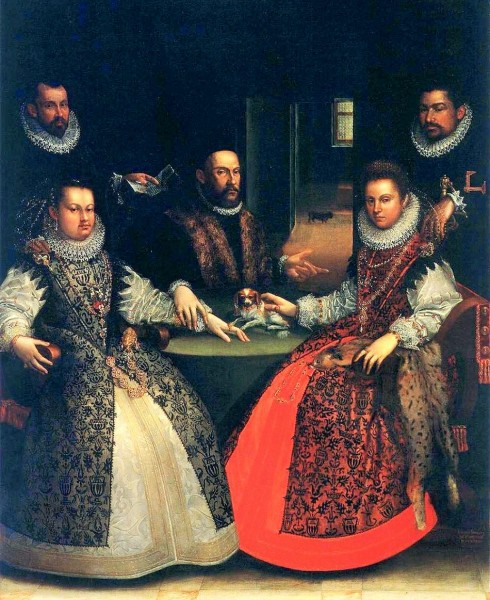
This is the Gozzadini family in 1584 (the painting is still in Bologna). The dog seems to be the only one having any fun, but perhaps things were more relaxed than they look. The painting has been interpreted at length as a visual illustration of the long and complex dramas that the Gozzadini family experienced in the latter half of the sixteenth century. The art historian Caroline Murphy believes that Laudomia Gozzadini (the patron in the red dress) confided her marital and financial problems to the artist who then depicted them, ever so subtly, in the painting.’ (There is more about the Gozzadini family here.)
20 February 2019
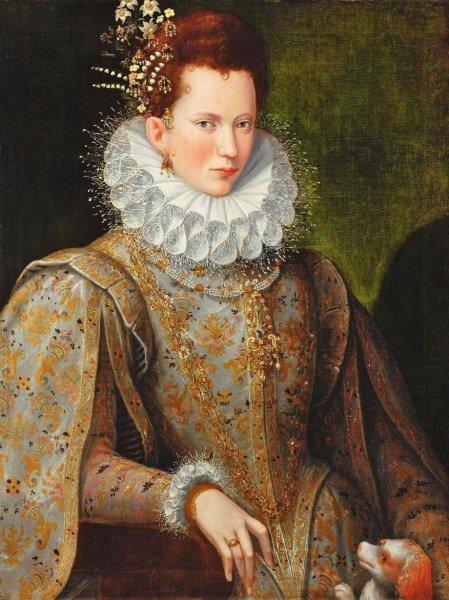
Portrait of a Lady with a Dog 1690s is owned by the Philip Mould Gallery in Pall Mall. The Philip Mould website comments: ‘Lavinia Fontana is considered to be the first woman to become a successful professional artist in Europe. Her oeuvre of over seventy works, to which the present picture is a new and hitherto unpublished addition, is the largest of any female artist before the eighteenth century. By the early 1580s Fontana was well established as a portraitist in her native Bologna. Her eye for detail allowed her to render with an unseen degree of realism the expensive fabrics and rich jewels of her sitters, a vital asset for portraying the intensely fashion conscious Bolognese. The present portrait, painted in the 1590s, is dominated by the elaborately depicted ruff, along with details such as the jewelled flowers in the sitter’s hair. It was painted when Fontana was at the height of her success in Bologna. The women of Bologna’s ruling elite, a collection of forty interwoven families known as the “Quaranta”, became so fond of Fontana that they vied amongst each other for her commissions. She was the closest thing Bologna had to a celebrity, and the city felt her loss when, in 1603, she moved to Rome, partly at the invitation of Pope Clement VIII. ‘
19 February 2019
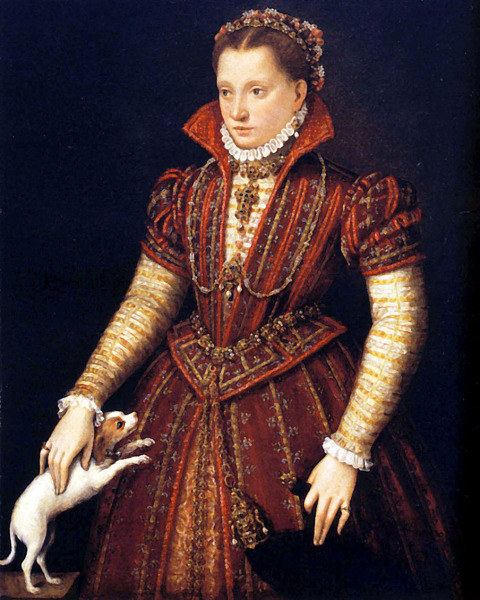
This is simply Portrait of a Noblewoman. It’s at the National Museum of Women in the Arts in Washington. ‘Recent scholarship has established that this painting of an unidentified, young Bolognese noblewoman is almost certainly her marriage portrait. Studies of account books and family diaries from this period show that the clothes and gems depicted here correspond precisely to the items typical of a high-born bride’s trousseau. Additionally, 16th-century Bolognese brides wore red dresses, and the dog represents marital fidelity. Suspended from the woman’s belt is a curious item mentioned in numerous family records of that time. It is the pelt of a marten—a slender, mink-like creature—whose head and paws are elaborately decorated with jewels. This adornment serves as an additional symbol of the bride’s wealth.’
18 February 2019
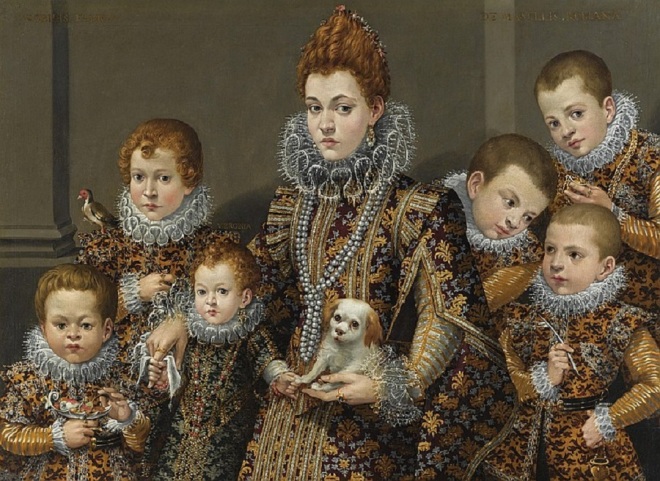
The five ‘forgotten’ women painters three weeks ago were all amazing but there was one that was especially unforgettable: Lavinia Fontana (1552-1614). She had a way of painting that made her subjects SO realistic, almost as though they were going to walk in to the room. Also the dogs (one every day this week) are sweet! This is Portrait of Bianca Degli Utili Maselli with six of her children. (It was first owned by the sitter’s family; then the Bartoli family; then the Marchetti Family; and then was sold at Sotheby’s in 2012. Who is the lucky owner now?)
15 February 2019
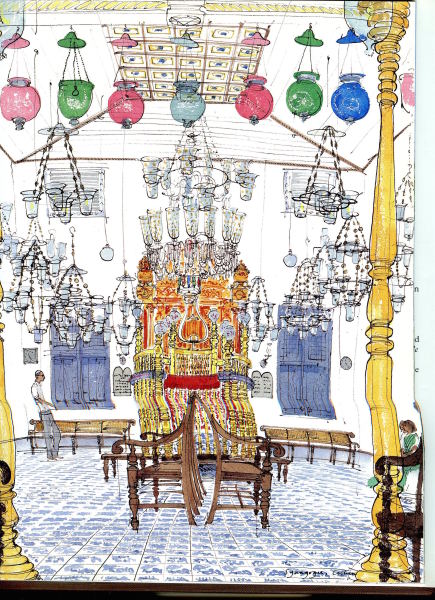
This was the Synagogue of the White Jews, now known as the Paradesi Synagogue, when David Gentleman was in Cochin in the early 1980s. We were nervous about the survival of this 1567 building – but it is unchanged, in particular the paintwork on the shutters is a marvellous and subtle blue-grey and the floor tiles, which are quite large, or rather larger than Dutch tiles normally are, a miracle of beauty.
14 February 2019

What everyone remembers about Cochin – the Chinese fishing nets, still here and still exactly the same.