
Find a book

A Book a Month
We can send a book a month for six or twelve months - the perfect gift. More »

Café Music
Listen to our album of Café Music while browsing the site. More »

A parallel in pictures to the world of Persephone Books.
To subscribe, enter your email address below and click 'Subscribe'.
21 May 2018

There is a new book published by the Imperial War Museum called London at War 1939-45: A Nation’s Capital Survives. The text accompanying this picture of a newspaper seller on September 3rd 1939 is as follows: ‘Mollie Panter-Downes, a middle-class housewife living in London and Surrey, wrote a column about the city for the New Yorker magazine. She left an evocative description of London’s changing landscape and Londoners’ changing habits on the first day of war: “On the stretch of green turf by Knightsbridge Barracks, which used to be the scampering ground for the smartest terriers in London, has appeared a row of steam shovels that bite out mouthfuls of earth, hoist it aloft and dump it into lorries; it is then carted away to fill sandbags. The eye has now become accustomed to sandbags everywhere, and to the balloon barrage, the trap for enemy planes, which one morning spread over the sky like some form of silvery dermatitis”‘ (taken from London War Notes, Persephone Book No. 111).
18 May 2018
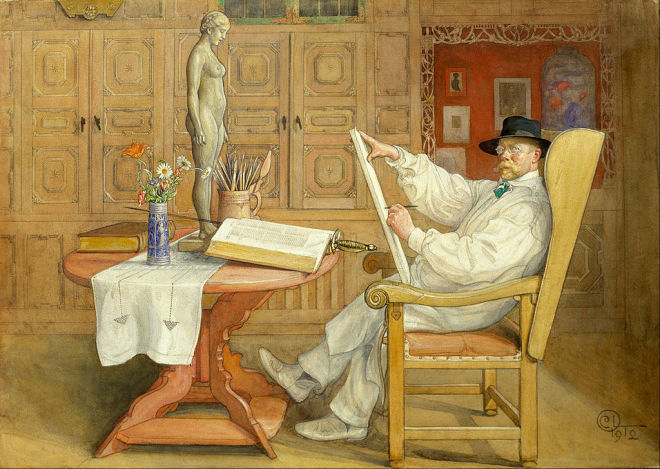
And here is the man himself: ‘Self Portrait (in the new studio)’ 1912. ‘The Larsson home in Sundborn, Dalarna, is one of the most famous artist’s homes in Scandinavia. The home was undergoing constant changes and extensions. The last extension was made in 1912 when a new studio for the artist was created. That same year Carl Larsson portrayed himself in the new studio, sitting in the so called grandfather chair. In front of him on the table he has a sculpture of a nude woman made by fellow artist Anders Zorn. On the table is a tablecloth that his wife Karin made and there are also paint brushes, a book and a sword’ (this last is a bit odd). Carl and Karin Larsson would live another seven years, until 1919. They were survived by seven children so there are a lot of Larsson descendants in Sweden today.
17 May 2018
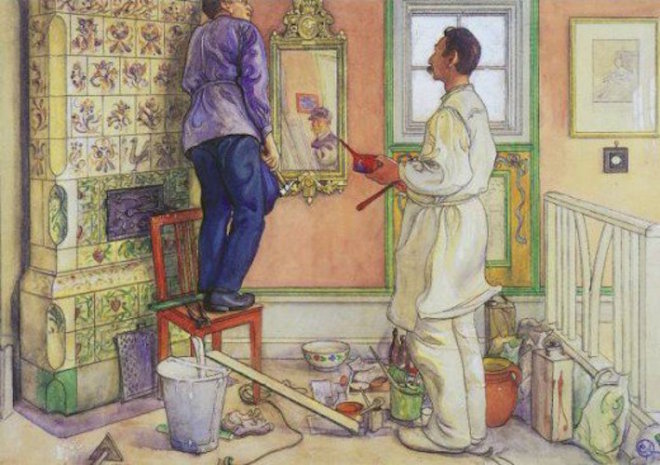
‘My friends the carpenter and the painter’ 1909. Only Larsson would have prefaced the title of this painting with the words ‘my friends’: everything about it is admirable.
16 May 2018
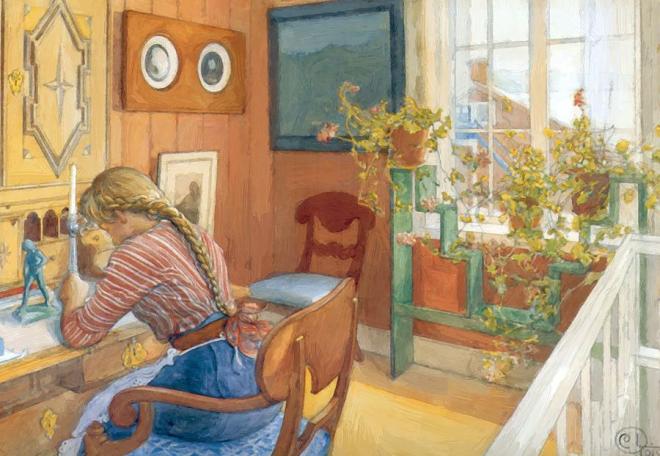
And here is ‘Correspondence’ 1912. The joy of all these less-familiar Larsson paintings is that they are very everyday: ordinary people doing ordinary things. And yet the family superbly follows William Morris’s precept: ‘Have nothing in your house that you do not know to be useful, or believe to be beautiful.’
15 May 2018
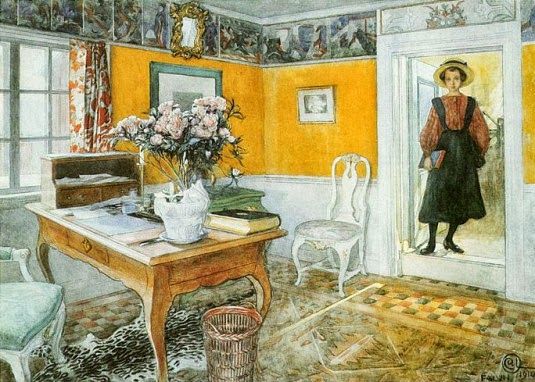
This is ‘School Girl in an Interior’ c. 1910, a painting that is at the Brooklyn Museum. What is marvellous about Larsson’s work is that it never seems staged: this is how it was, it’s as though someone has just that second pushed their chair back from the desk and got up to say hello to the young girl, who is tired.
14 May 2018
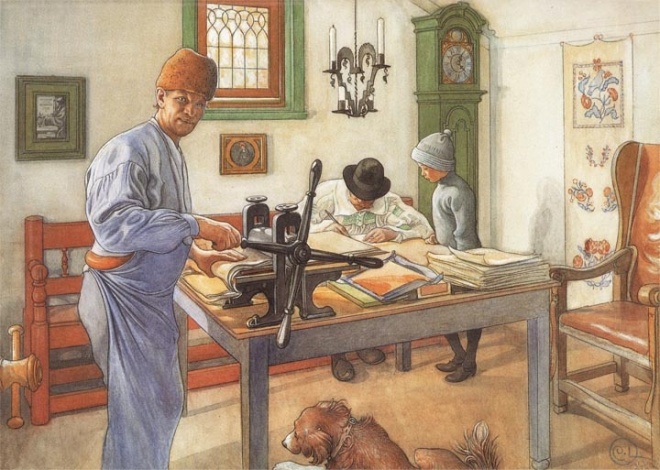
After European children’s toys last week, the Post can morph seamlessly into the European domestic in painting – and of course this has to be the Swedish artist Carl Larsson who had such a huge influence on visual representations of C20th domesticity. Much of his work is very well known indeed, almost too well-known – so this week on the Post a selection of the much less well-known paintings. This is ‘Where I Do My Etchings’ 1910.
11 May 2018
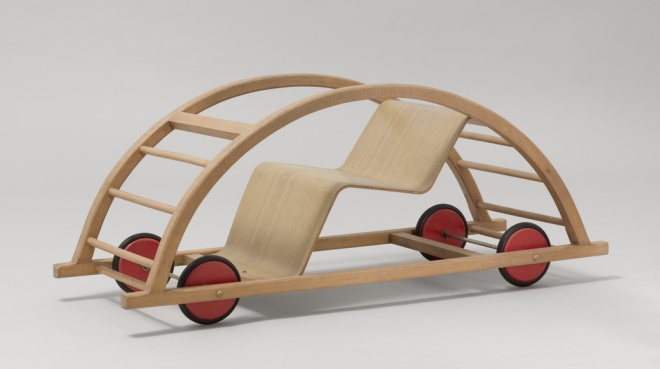
This is the star of the show – any child would love this and any adult would love to have this around in their living room. Lots to think about in this exhibition. ‘To what extent do [these kind of toys] privilege standardisation, geometry and simplification, the principles we associate with industrial production and a modernist vision of the future? But is there an alternative, a genuinely intuitive toy?’ This is Hans Brockhage and Erwin Andrä’s Rocking Car 1950. The exhibition is on until the end of August.