
Find a book

A Book a Month
We can send a book a month for six or twelve months - the perfect gift. More »

Café Music
Listen to our album of Café Music while browsing the site. More »

A parallel in pictures to the world of Persephone Books.
To subscribe, enter your email address below and click 'Subscribe'.
11 May 2018
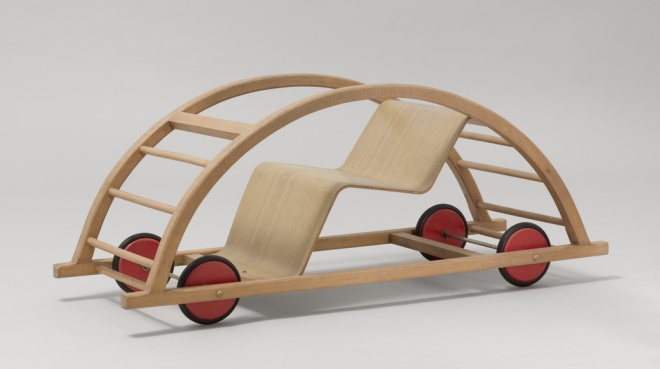
This is the star of the show – any child would love this and any adult would love to have this around in their living room. Lots to think about in this exhibition. ‘To what extent do [these kind of toys] privilege standardisation, geometry and simplification, the principles we associate with industrial production and a modernist vision of the future? But is there an alternative, a genuinely intuitive toy?’ This is Hans Brockhage and Erwin Andrä’s Rocking Car 1950. The exhibition is on until the end of August.
10 May 2018
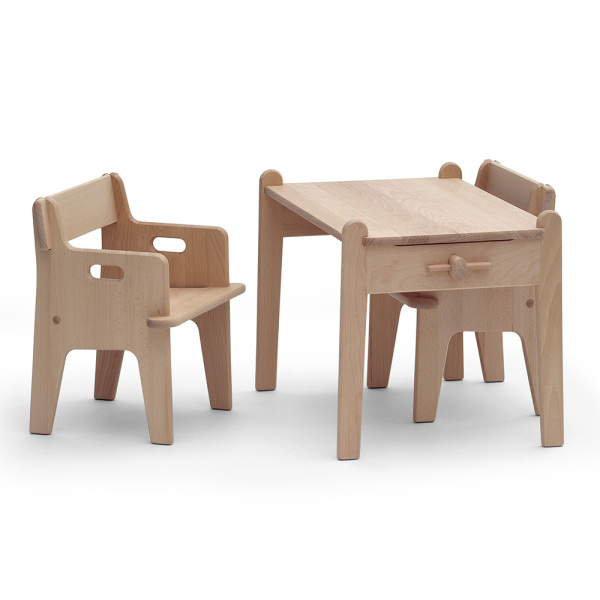
‘Also known as Peter’s Chair and Peter’s Table, the CH410 and CH411 respectively, were designed by Hans J. Wegner in 1944. Sturdy and safe, they are made from four pieces of wood that can be assembled and disassembled again and again–no tools are necessary. In fact, Peter’s Table and Chair were one of the first “knock-down” furniture designs ever. This makes the chair functional and a great toy for children. Peter’s Chair and Table were designed by Wegner as a present for the baby son of Wegner’s friend and colleague, Børge Mogenson.’ They are in the exhibition but you can still buy them here.
9 May 2018
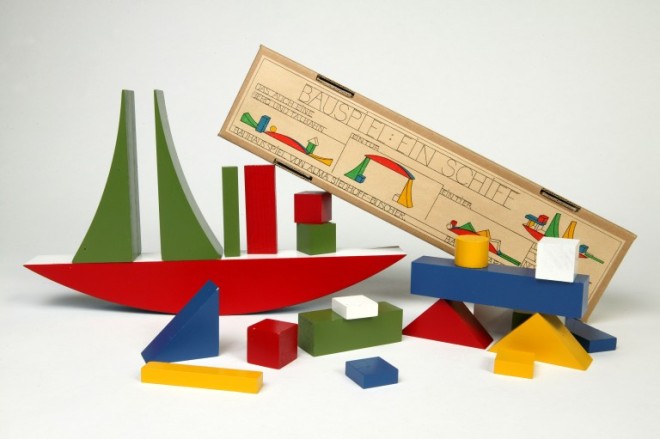
Set of 1923 Bauspiel construction blocks by Alma Siedhoff-Buscher (1899-1944). These are in fact already in the V and A collection: this particular set was manufactured in Switzerland in 1988 and seems to have been given to the Museum of Childhood pretty well straightaway. Stephen Hayward calls this a ‘Bauhaus toy’ and asks: to what extent do toys like this ‘privilege standardisation, geometry and simplification, the principles we associate with industrial production and a modernist vision of the future? But is there an alternative, a genuinely intuitive toy?’ (Sometimes we put a set of 1907 German building blocks in the window in Lamb’s Conduit Street. They were inherited from an ancestor and have been played with by three generations. But do they have a greater influence than one thinks? Do they create people interested in standardisation and simplification? Surely not. But it does make one think – what’s in a toy? How much influence does it have? Are a child’s choices, or the direction it takes in life, influenced from the very earliest moment by the toys he or she is given to play with? Interesting…)
8 May 2018
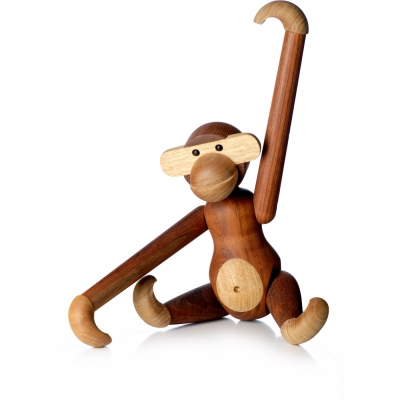
Children’s toys are an aspect of childhood rarely discussed on the Post. The Montessori method is quite often mentioned (Dorothy Canfield Fisher was a huge proponent) and of course design and domesticity are constant tropes. But toys not so much. Although many of us have held on to some of our Galt or Paul and Marjorie Abbatt wooden toys: they were so beautifully designed that they can be part of the furniture not just for small children to play with but as objects of beauty in their own right. Now there is an exhibition at the V and A Museum of Childhood called ‘Century of the Child: Nordic Design for Children 1900 to Today’. This inspired Stephen Hayward to write an article about Scandinavian design and children and on the way he threw up many interesting themes. Here is the article. The first section, on Nordic design, ends: ‘To what extent is Kay Bojesen’s wooden monkey a contemporary antique, an accessory for slow living, or a toy that is too good to be played with?’
4 May 2018
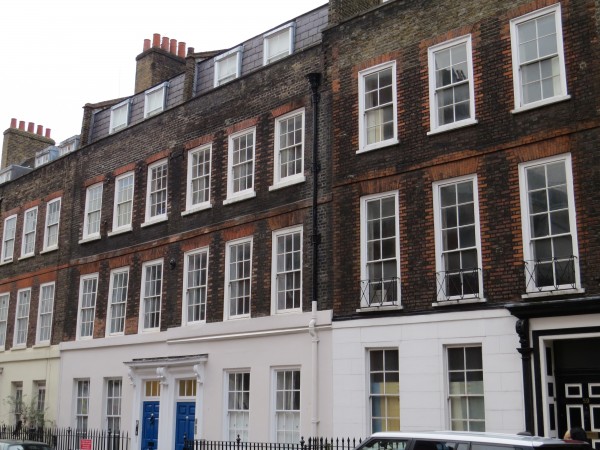
William Morris was one of the founders of SPAB, the Society for the Preservation of Ancient Buildings, in 1877, more details here. It was established in response to the work of Victorian architects whose enthusiasm for harmful restoration caused irreparable damage. These two houses, 41-43 Great Ormond Street with the blue doors, were the SPAB’s first premises. The rooms on the first floor were knocked through, which was useful for lectures and committee meetings. Motto for today: ‘We are only trustees for those that come after us’ William Morris.
3 May 2018
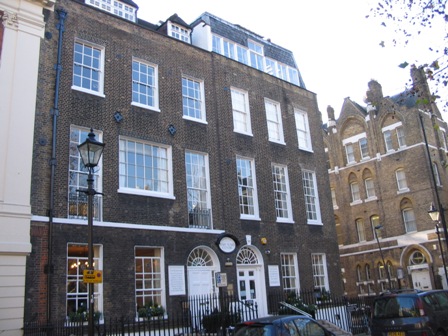
The Female School of Art was founded in 1842 with the aim of enabling ‘young women of the middle class to obtain an honourable and profitable employment’. At first it was in Gower Street but by 1861 had moved to 43 Queen Square. In the early twentieth century it amalgamated with the Central School of Art. More details here, at the excellent UCL Bloomsbury Project site. Nowadays number 43 is the admirable Mary Ward Centre.
2 May 2018
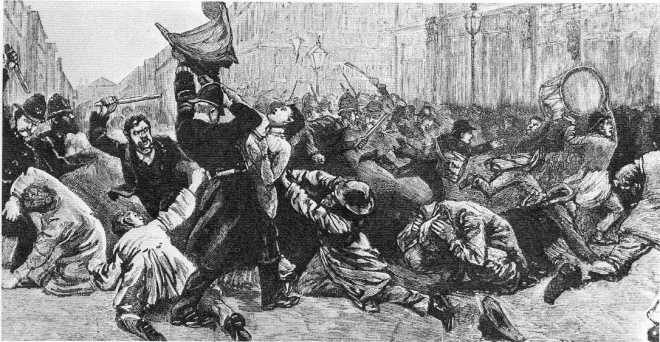
On the walk we stopped in Theobalds Road to pay tribute to the people killed and injured in the March on Sunday 13th November (‘Bloody Sunday’) 1887 from Clerkenwell Green to Trafalgar Square. Morris walked at the head of the 10,000 marchers demonstrating against unemployment; they were ambushed by mounted cavalry at the top of Shaftesbury Avenue. The police were appallingly brutal. This was a deeply disillusioning and upsetting experience, especially for Morris. More details here. (A pity this post wasn’t up yesterday, May Day.)