
Find a book

A Book a Month
We can send a book a month for six or twelve months - the perfect gift. More »

Café Music
Listen to our album of Café Music while browsing the site. More »

A parallel in pictures to the world of Persephone Books.
To subscribe, enter your email address below and click 'Subscribe'.
10 November 2017
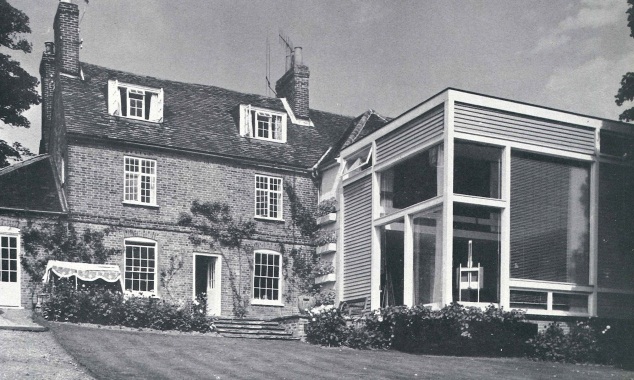
Finally, the extremely characterful Jane Drew. The obituary here includes the detail that ‘she was educated at Croydon Day School. One of her classmates was Peggy Ashcroft, with whom she made a secret pact: that they would pursue a career and always use their own names – both kept it throughout their long distinguished careers.’ Jane Drew’s early work was ‘influenced by Georgian style – “Good Georgian, not rotten Georgian”, she said later – but soon she became involved in the Modern Movement.’ And this is an understatement. This studio at Hertingfordbury in Hertfordshire was for the fabric designer Ashley Havinden (he designed the beautiful fabric we used for Someone at a Distance) but poor him, having such an ugly workroom attached to his house. It’s all very well to say here that ‘it was decided to make no attempt to continue the style of the existing house, which is an amalgam of early Georgian and Victorian additions, and the new studio establishes its own scale and proportions based in three dimensions on an approximation to the golden section.’ The result is unpleasing. But Jane Drew was one of, if not the, greatest architects of the twentieth century. So what do we know? (Some of us have always longed for a swing seat, they are so incredibly comfortable, but to put one outside and give it a frilly canopy cannot have pleased the Queen of Modernism!)
9 November 2017
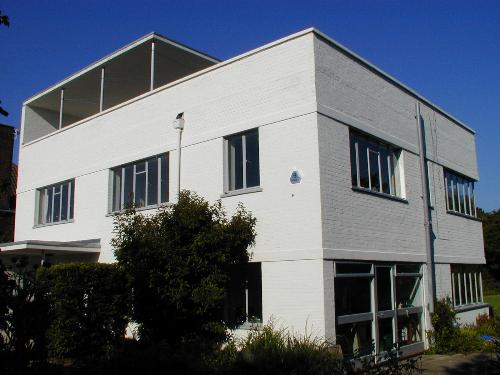
Another house in Cambridge (is it just coincidence that three of our five buildings by 1930s female architects are in Cambridge?), this time 9 Wilberforce Road (1937) by Dora Cosens, a pupil, at the University of Cambridge School of Architecture, of George Checkley, one of whose houses in nearby Conduit Head Road, she extended in 1944. (The internet does not even offer Dora Cosens’s dates, if anyone knows anything about her please do let us know so we can update this post.)
8 November 2017
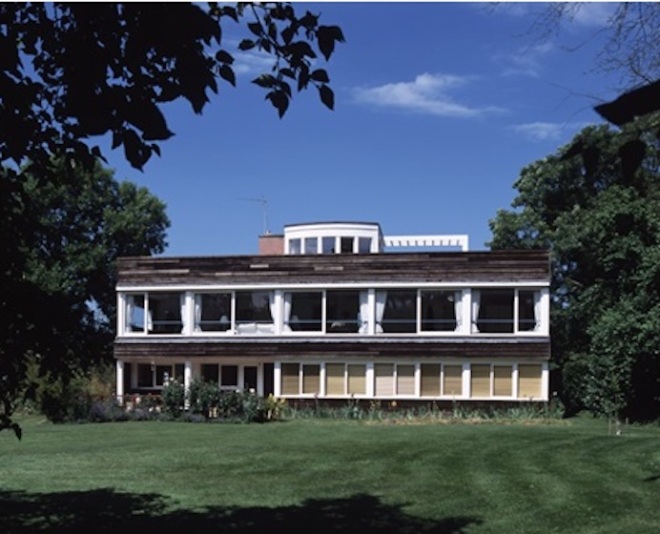
(Margaret) Justin Blanco White, who trained at the Architectural Association, designed Shawms, Conduit Head Road, Cambridge in 1938 when she was 27. Later she worked on low cost housing for the elderly, and on hospitals. Her mother and grandmother were both Persephone authors, Amber Reeves and Maud Pember Reeves.
7 November 2017
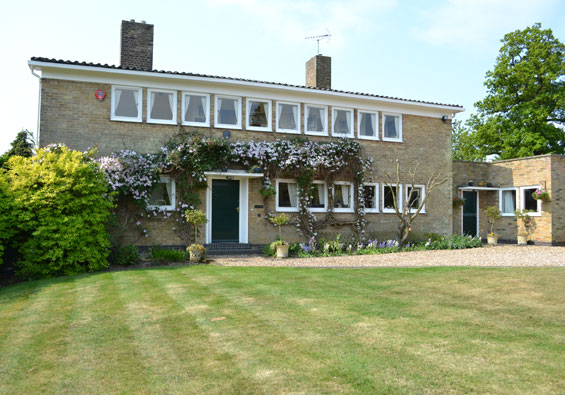
Mary Medd (née Crowley and sometimes called Mary Crowley) built this house, Sewell’s Orchard at Tewin in Hertfordshire, in 1934, when she was 27; some details here (when it was for sale) and lots more here. ‘Having built three residential homes, Mary Medd pursued a career in the public sector, designing school buildings for the government. This made for a career well away from the public eye and may explain why she is not as well known today as she deserves to be. Yet Mary Medd was one of Britain’s pioneering Modernist architects. She worked with Erno Goldfinger, who had great respect for her work: his Willow Road houses (1939) share the square window motif seen at the rear of Mary Medd’s house.’
6 November 2017
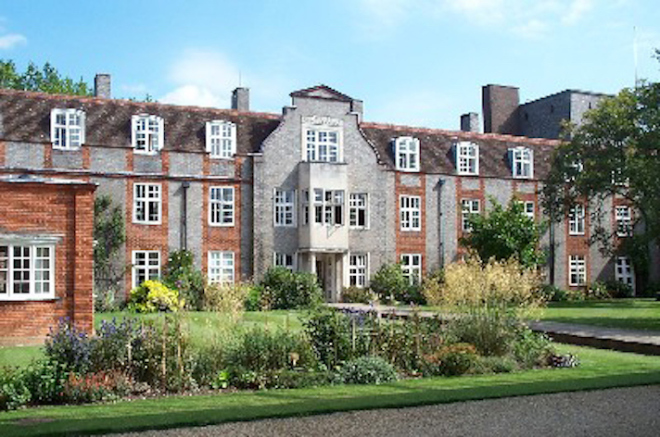
Five twentieth-century women architects this week: first of all, Elisabeth Scott who is best known for the Shakespeare Memorial Theatre at Stratford but of course we love for the beautiful Fawcett Building at Newnham College, Cambridge (1938). She has shot to fame recently because it was announced that she would be one of only two British women (the other being Ada Lovelace) to be featured in the design of the new UK passport.
3 November2017
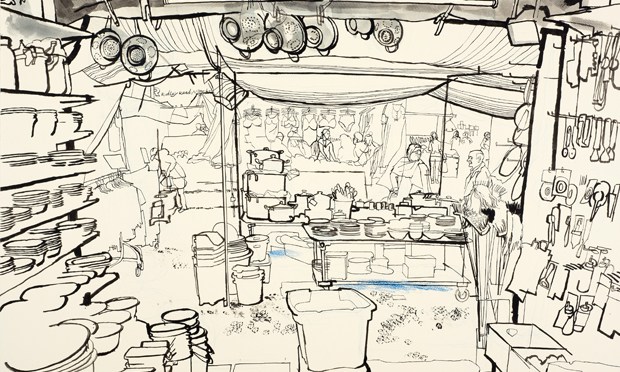
Crowded View from the Kitchen Shop. ‘One of the things that’s clear to me from coming down here [to Ridley Road],’ says Lucinda Rogers, ‘is that the social side to the market is incredibly important… The cultural side too – there’s stuff here you can’t buy elsewhere, culturally important ingredients. But at the end of the road there’s this gigantic building, this sort of lump, which physically is a completely different world.’ That we have allowed so many lumps in London is one of the most shocking things about life here in the last fifty years. And once a lump has lumpishly been built – it’s there for ever and ever. Lucinda Rogers’ work celebrates all the values which are opposed to lumpishness: the small-scale, the delightful, the spirit-lifting as opposed to spirit-lowering and, dare we say it, the feminine. Next week on the Post: five twentieth century women architects who did excellent (as opposed to lumpish) work.
2 November 2017
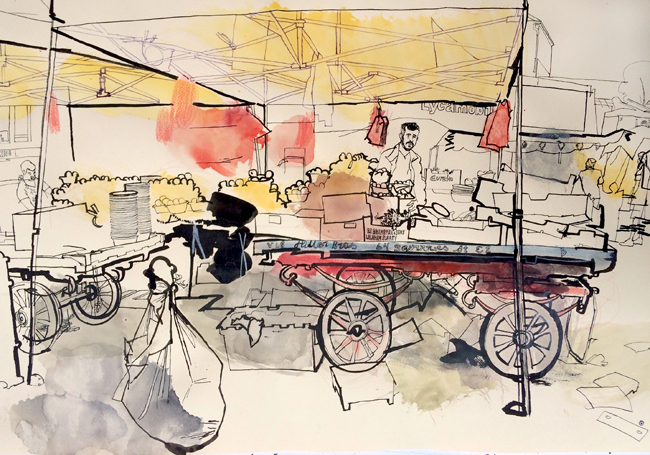
A Ridley Road Market Stall. The use of colour is particularly clever here – just a touch and just two colours. We now stock Lucinda Rogers greetings cards in the shop or they are of course available directly from her here.