
Find a book

A Book a Month
We can send a book a month for six or twelve months - the perfect gift. More »

Café Music
Listen to our album of Café Music while browsing the site. More »

A parallel in pictures to the world of Persephone Books.
To subscribe, enter your email address below and click 'Subscribe'.
1 April 2016
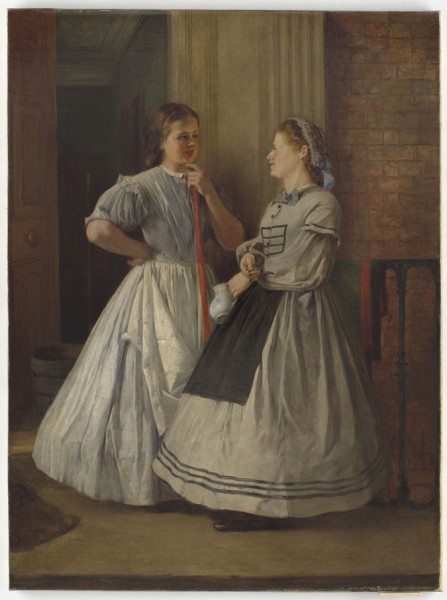
Maids of All Work by John Finnie was painted in 1865, It is not completely clear that both the girls are maids, both are wearing some kind of crinoline and the girl on the right with her little apron just might be the daughter of the house – her pose is more authoritative, even though the other one has her hand on her hip in a quite confident way. Maybe the title is ironic/realistic – the daughter of the household and the maid are both maids of all work. Or maybe both girls have posed.
31 March 2016
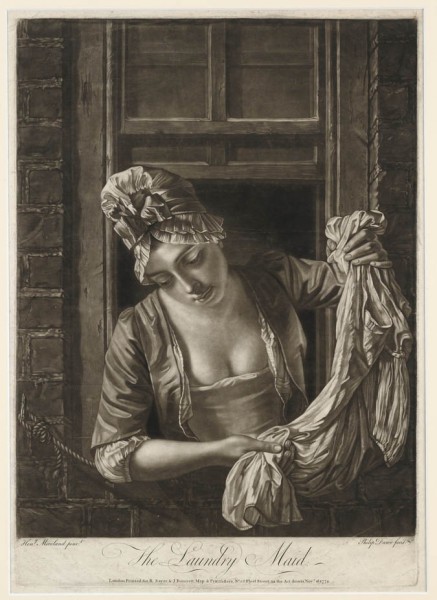
The Laundry Maid 1774 is by Philip Dawe after Henry Morland. The imagery of this picture is a bit confusing to the modern eye but there is a free talk at the Geoffrey on May 13th at 1 pm, ‘Servants in London Households 1700-1800’, which will certainly elucidate. Here is the Morland colour original in which the maid is much more decorously dressed.
30 March 2016
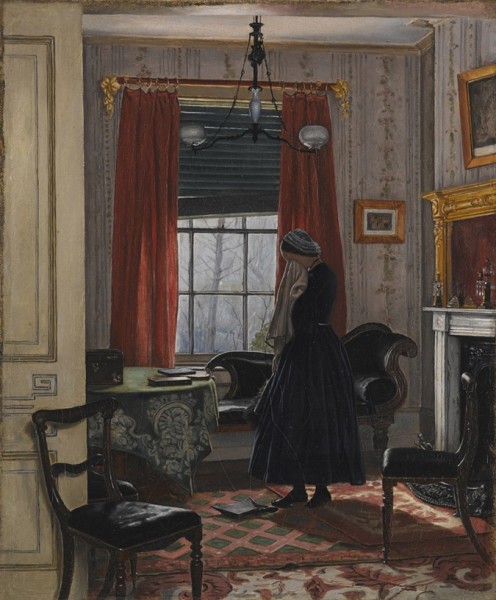
The First Place by A Erwood c.1860 was on the Post before, a year ago, when it was purchased by the Geffrye Museum with the help of the Art Fund. It wrote at the time: ‘She has been sweeping the hearth (or carpet) using a dustpan and brush. The title indicates the source of her unhappiness – she is overcome with the difficulties of her first position, away from her own home and family. It provides an accurate and detailed view of a mainstream middle-class home. It is also unusual because its subject is a servant’s experience. The experience of servants has tended to be overlooked by historians and they are under-represented in the museum’s galleries.’ And this was from the 2008 Sotheby’s catalogue when the painting was sold: ‘Although recording a moment in time in a manner typical of much Victorian painting of this date, the execution and setting of the work is in some ways very modern. It is an intriguing vision into the current interiors of the 1860s, much of the furniture being near contemporary and very much the fashion at this date. The style of its execution, such as the play of light through the window and its painterly technique, also looks forward to British painting at the end of the nineteenth century.’
29 March 2016
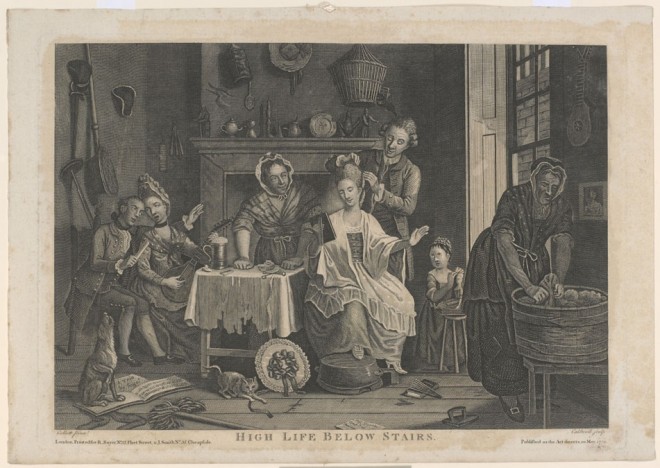
An exhibition called Swept Under the Carpet? has just opened at the Geffrye Museum ‘exploring domestic service and the experiences of servants living and working in middle-class homes over the last four hundred years, giving a glimpse into a world often overlooked by historians. New scenarios and subtle interventions in the museum’s period rooms will illustrate the changing nature of the servant’s work and the relationship between master and servant over time – from the intimacy of a maid checking her master’s hair for nits in the late 17th century, to an ayah caring for the children of an Angle-Indian family in the late 19th century, to a French au-pair picking up after the children she looks after in 1960.’ High Life Below Stairs (1772) is by James Caldwell after John Collet.
25 March 2016
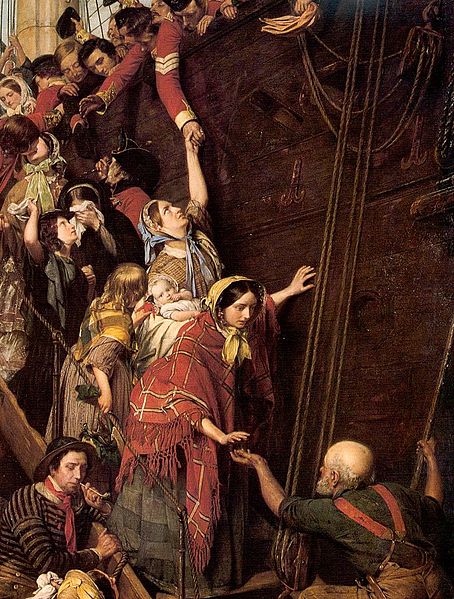
The subject of Eastward Ho! by Henry Nelson O’Neil is the scene on a steamer bound for Calcutta that was taking the troops to the Indian ‘‘Mutiny’’(1857-9, otherwise known as the First Indian War of Independence). The painting was shown at the 1858 Royal Academy Exhibition along with In Memoriam (on the Post yesterday); it was so popular that it toured Britain and an estimated half a million people saw it. There is more on the painting here and here.
24 March 2016
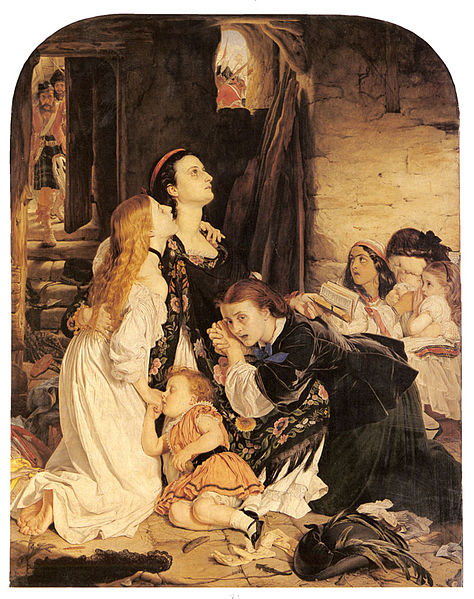
In Memoriam by Joseph Noel Paton was painted in 1858. The year before ‘British rule in India was challenged when Indian sepoy troops of the British Indian Army began a year-long insurrection against the British. To the British, the most shocking aspect of the events in India was the massacre of white women and children by Indian men. There was extensive coverage in the press and illustrated journals, which stimulated calls for revenge. Paton’s famous painting In Memoriam was dedicated by the artist to the Christian heroism of “British Ladies in India during the Mutiny of 1857.” In 1858, the first version of the painting, which depicted Indian sepoy troops bursting through the door, was exhibited at the Royal Academy of Art in London. The painting aroused immediate debate, as it was thought to suggest that British women were about to be raped by Indian soldiers. The review in The Illustrated London News on May 15 1858 stated: “The subject is too revolting . . .The picture is one which ought not to have been hung.” Although British women and children were known to have died during the insurrection, there was no evidence of rape. The artist painted out the Indian soldiers in the original painting, and substituted Scottish highlanders. It was this version that was engraved and sold, leaving intact the myth of the British woman as sexually inviolable by colonial men’ (Women in World History Module 8). There is another longer piece about the imagery of the painting here. (Nb. We were asked to choose five crucial books by AnOther Magazine and the first of these was of course A Passage to India, here.)
23 March 2016
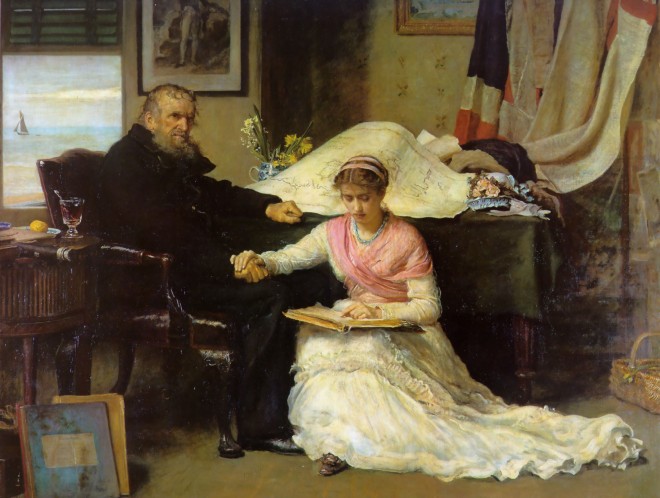
The North-West Passage by Millais: this was the unnavigable sea route round North America which was thought to provide a passage to the East. In time, it became synonymous with failure, adversity and death, with men and ships battling against hopeless odds in a frozen wilderness. Millais painted this picture in 1874 when another English expedition was setting off: he encapsulates the risks of such a voyage through the old seaman, with his grim, distant look and clenched fist.