
Find a book

A Book a Month
We can send a book a month for six or twelve months - the perfect gift. More »

Café Music
Listen to our album of Café Music while browsing the site. More »

A parallel in pictures to the world of Persephone Books.
To subscribe, enter your email address below and click 'Subscribe'.
12 April 2016
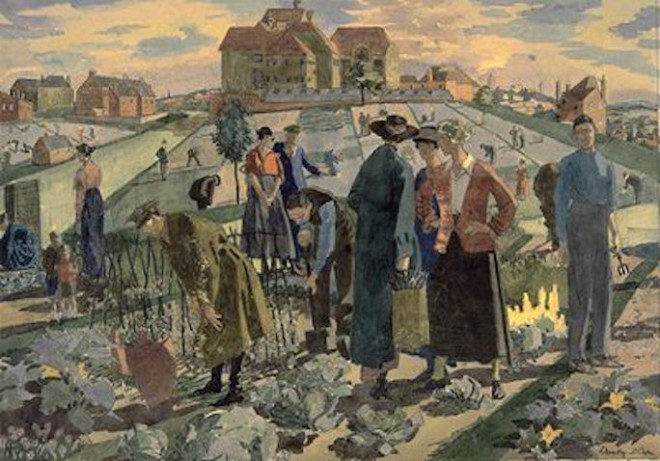
War Allotments in a London Suburb was also painted by Dorothy Coke in 1918: sadly, this painting, and the one that was on the Post yesterday, are apparently the only two surviving from her First World War output. (In the background is the County Council School at Norbury, used as a Military Hospital.)
11 April 2016
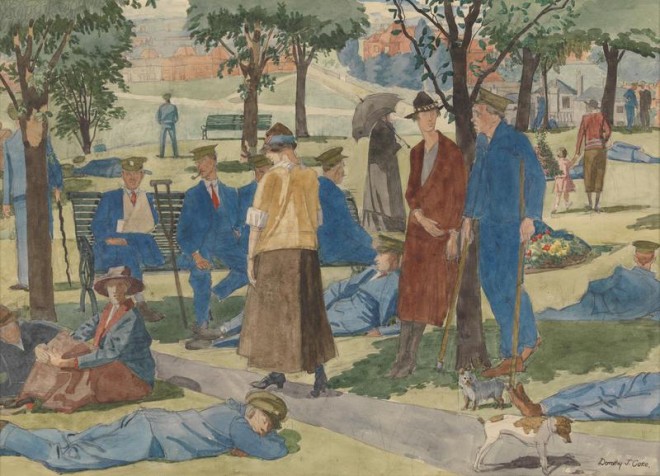
Trying to find out more about Flora Lion and Anna Airy led to the discovery of a third completely overlooked First World World War painter, Dorothy Coke (1897-1979, it’s pleasing that all three artists had long lives). But of course this is entirely our ignorance as Dorothy Coke has not been ignored by the cognoscenti – Neil Jennings had an exhibition of her work at the Artworkers Guild in the late autumn of 2014, and there was a retrospective at The Grange Art Gallery in Rottingdean last summer (she taught at Brighton from 1939-67 and lived in Eley Crescent, Rottingdean throughout her working life). Wounded Men on Duppas Hill, Croydon 1918 is a watercolour showing ‘soldiers resting in a park on a bright day. They are the war-wounded wearing their distinctive uniform, some with crutches, others bandaged limbs’ Imperial War Museum, Dorothy Coke was only 21 when she drew this.
8 April 2016
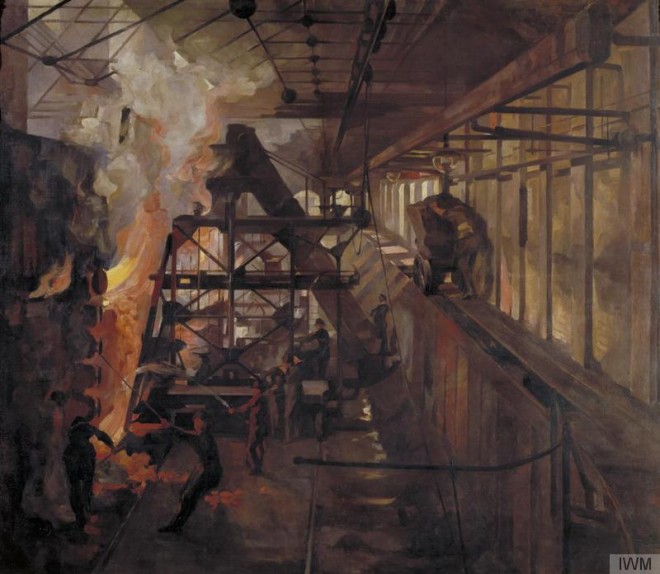
Women Working in a Gas Retort House: South Metropolitan Gas Company, London. The lack of information and general awareness of the work of Flora Lion and Anna Airy, unsung geniuses both, is quite astonishing; and now the tiny bit of research we have been able to do on them has thrown up Dorothy Coke, the third British war artist of the First World War of whom we had never heard – she will feature on the Post next week. Why oh why can’t Tate Britain, or indeed York Art Gallery, have exhibitions of one or all of these three? Answer comes there none of course because we all know why.
7 April 2016
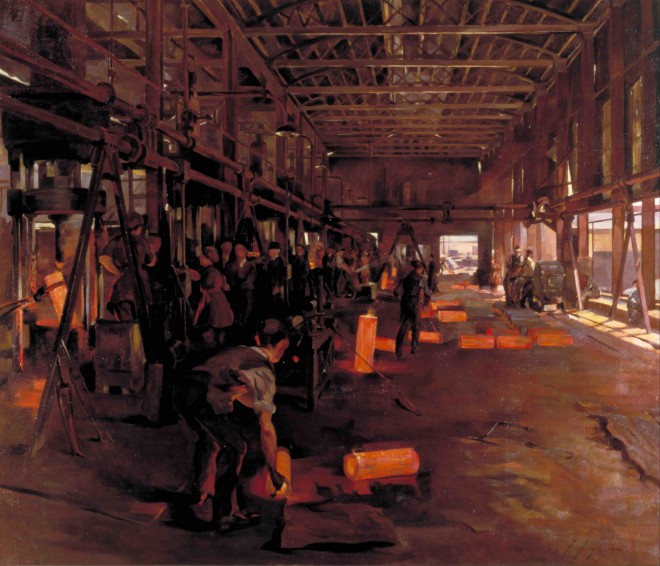
Anna Airy painted A Shell Forge at a National Projectile Factory, Mabley Green, Hackney Marshes in 1918. ‘This piece was a particular challenge because she had to work with great speed to capture the colour of the molten shells. The tremendous heat of the interior added to the intensity, and one one occasion the ground became so hot that allegedly her shoes were burnt off her feet’ IWM. Nb. Mabley Green sits in the shadow of the 2012 Olympic Park. There was a very good piece in the Independent about women war artists here.
6 April 2016
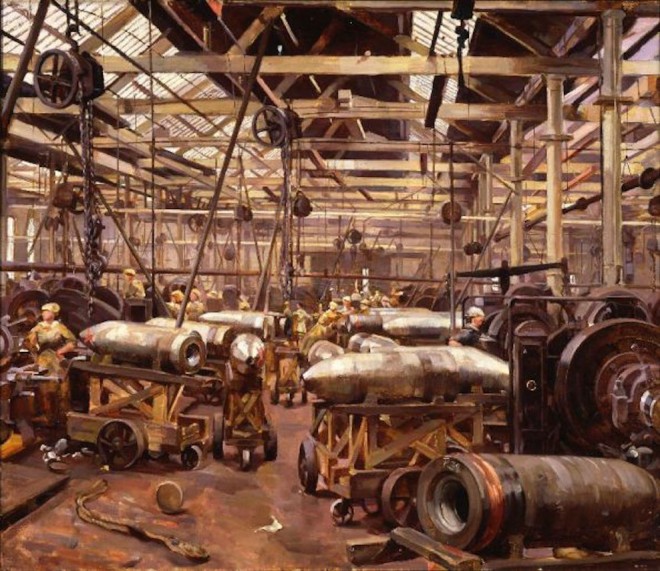
Anna Airy is the other amazing but unsung painter whom we discovered in York. ‘A contemporary of William Orpen, Anna Airy trained at the Slade School of Art. She was one of the first women war artists, employed by the newly founded Imperial War Museum in 1918. Although a well-respected and successful female artist of her generation, the Munitions Sub-Committee of the IWM, which commissioned her, imposed strict terms on her contract of employment. These terms included their right to refuse a work and not pay for it. However, she successfully painted four large works for the Sub-Committee, each representative of a typical scene at a munitions or armament factory. Airy’s determination and adventurous spirit prepared her for the difficult conditions under which she had to paint inside the factories’ (Imperial War Museum site; this last comment seems something of an understatement). This is Shop for Machining 15-inch Shells: Singer Manufacturing Company, Clydebank, Glasgow.
5 April 2016
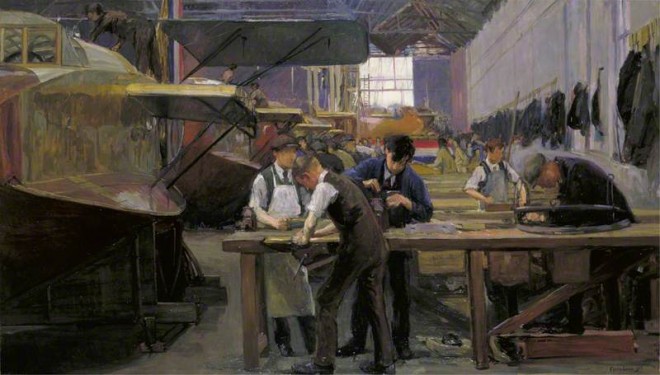
This 1918 Flora Lion is also in the First World War exhibition in York, it is called Building Flying Boats and is equally extraordinary technically (although perhaps not quite so heart-stoppingly memorable – that blue dress! the two young women in the foreground!). This is what the Imperial War Museum site says about Building Flying Boats: ‘Flying boats (designed with a boat-like fuselage for landing and take off from water) were used extensively by the British during WWI, notably for spotting German U-boats by following mathematically constructed search patterns. Although the technology of flight demanded precision design and the use of the aircraft was sophisticated, they are being manufactured using traditional carpentry skills. Workmen at benches, using planes and scrapers, are hand manufacturing the individual components for this most modern machine. The setting is probably the Belle Vue Barracks, Manningham, Bradford where many planes were assembled.’
4 April 2016
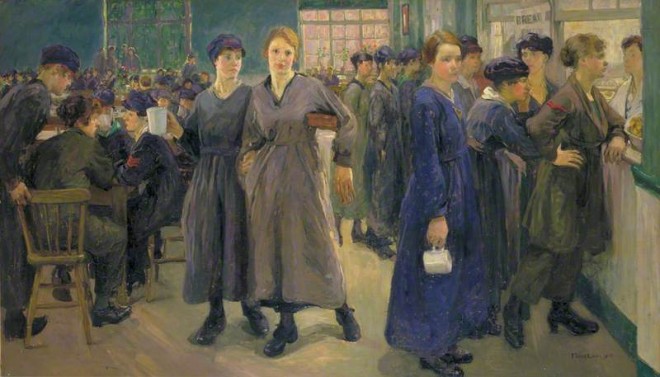
To York and there in the the magnificent Art Gallery is the newly opened exhibition of First World War paintings; it was at the Imperial War Museum but is somehow (better hung? more paintings?) even more extraordinary and, without wanting to sound soppy, awe-inspiring. The stars for us, naturally, were the paintings by Flora Lion and Anna Airy. This is Flora Lion’s Women’s Canteen at Phoenix Works, Bradford 1918. It is huge (two metres across) and knockout, worth a day in York from anywhere in the country for this painting alone: the colours, the life, the way your eye is immediately and curiously drawn to the white china mugs, the beauty of the clothes – and you can almost hear the babble of conversation from all the women in the room. It’s the women in William – and Englishman and The Happy Tree come to life. Is anyone writing a book about Flora Lion? Is anyone writing a PhD? We think not…